2026 guide to house cleaning around a new baby in DFW: a pre-arrival deep clean at $200–$450, nursery and product safety, and recurring visits at $120–$250.
The weeks before a baby arrives are when a lot of DFW households call a cleaning service for the first time, and the weeks after are when they are most glad they did. As of October 2026, the pattern we see work best is a single deep cleaning at $200–$450 a few weeks before the due date, followed by a recurring standard cleaning at $120–$250 per visit through the first months of the baby's life. This guide covers what to clean before the baby comes home, which products are and are not appropriate around a newborn, how to get real help in the postpartum weeks without adding a single thing to your list, and what a sustainable cleaning schedule looks like once the household finds its new rhythm.
Before the Baby Arrives: The Deep Clean
The nesting instinct is real, and it tends to arrive in the third trimester at exactly the point when bending, kneeling, and scrubbing are least comfortable. This is the moment for a professional deep clean. It resets the whole home to a baseline you will not have time to reach again for a while, and it reaches the places a standard clean does not: grout, vents, the tops of door frames, behind and beneath furniture, light fixtures, and the inside of the oven and refrigerator.
Timing matters. Scheduling the deep clean two to four weeks before the due date gives you a clean home for the arrival without being so early that it slips before the baby comes. If the baby arrives early, the home is already done; if the baby arrives late, a standard visit a week or two later keeps it there. If you are starting a recurring plan, book the deep clean as the first visit so the regular visits that follow are maintaining a clean baseline rather than recovering one. Our guide to what to expect from your first house cleaning walks through that initial visit.
A few areas deserve specific attention in a pre-baby deep clean:
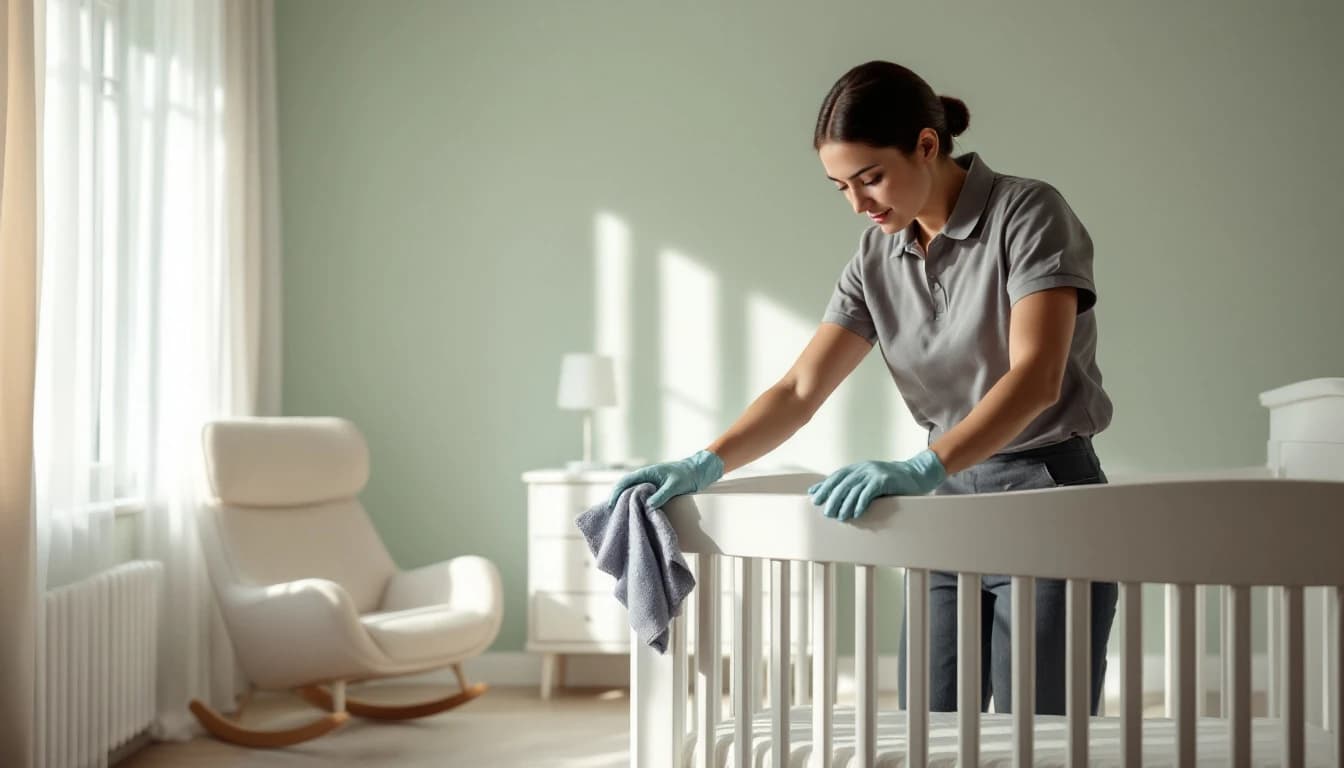
- The nursery, obviously, including inside the closet and dresser drawers, the ceiling fan, the window and blinds, and the floor edge to edge. Dust that has been sitting in an unused room for months needs to come out before the crib goes in.
- Soft surfaces throughout the home — upholstery, rugs, curtains — because they hold dust and, in homes with pets, dander. The U.S. Environmental Protection Agency's guidance on indoor air quality is clear that contaminants settle into fabrics and furnishings, which is exactly where a newborn spends the day.
- The kitchen, with the refrigerator interior done, because bottles, pumped milk, and eventually baby food are about to move in.
- Bathrooms, descaled and sanitized, since the first weeks involve a lot of hand-washing and a lot of visitors.
- Vents and filters, because the HVAC will run constantly to keep the nursery at a steady temperature, and clean returns move cleaner air.
Products: What Is Safe Around a Newborn
The products question comes up on nearly every pre-baby call, and the honest answer is that the ordinary professional-grade cleaners used in a standard visit are safe in a home with a baby as long as they are used correctly, rinsed where they should be rinsed, and given time to dry before the baby is in the room. What changes with a newborn is the margin for error, so a few principles apply.
- Avoid strong fragrances and aerosols in the nursery. A newborn's airway is small, and heavy scents linger in a closed room. Unscented or lightly scented products are the better choice, and the nursery should be aired after cleaning.
- Never mix products, and keep ammonia and bleach apart from each other and from everything else. Our guide to cleaning chemicals you must never mix explains which combinations produce dangerous fumes.
- Prefer plain soap and water or gentler cleaners on the surfaces the baby will touch: crib rails, changing table, high chair tray, toys. Stronger disinfectants are appropriate on toilets and sinks; they are rarely needed on a crib.
- Let surfaces dry completely before use. Most of the risk from any product comes from residue, not from the product itself.
- Store everything up and away. This matters more as the baby becomes a toddler, but the habit is easier to build now.
Households that want to go further can switch the whole home to lower-impact products; our overview of eco-friendly cleaning products for DFW homes covers what works and what is mostly marketing. Tell the crew at booking if you want the nursery done with specific products — many parents leave their own preferred cleaner on the changing table, and that is a perfectly normal request.
After the Baby Arrives: Help Without Adding to the List
The postpartum weeks are the stretch when a cleaning service earns its keep. Sleep is fragmented, one parent is recovering physically, and the home fills with bottles, laundry, and visitors faster than anyone can keep up with. The point of a cleaning visit in this period is not a spotless home; it is removing one entire category of work from two exhausted people.
Practically, that means:
- Book the first postpartum visit before the baby comes, for a date one to two weeks after the due date, so it is already on the calendar and no one has to arrange it from a hospital bed. It can always be moved.
- Ask for the visit to focus where it matters. Kitchen, bathrooms, the nursery, and floors. If the home office goes undusted for a month, no one will notice.
- Add laundry or dishes as an add-on for the first few visits. They are small charges and they are the two tasks that pile up fastest with a newborn.
- Leave the baby's things where they are. The crew works around bassinets, bottle-drying racks, and the swing in the middle of the living room. You do not need to tidy for the cleaners.
- Do not be home for it if you can help it, or be home and rest. The visit is quieter than you expect, but a sleeping baby and a vacuum are not a natural pairing, so many parents time the visit for a walk or a feeding in another room.
Families who already use us on a recurring plan usually move up a step — monthly to bi-weekly, or bi-weekly to weekly — for the first two or three months, then settle back. That is a scheduling change, not a new quote, and we expect it.
A Cleaning Schedule for the First Year
Once the household finds its footing, the question becomes what schedule to keep. Here is how it typically plays out, with the ranges that apply as of October 2026.
| Stage | Recommended visit | Typical price | Why |
|---|---|---|---|
| 2–4 weeks before the due date | Deep cleaning | $200–$450 | Reset the whole home, nursery included, before the baby arrives |
| First 3 months | Weekly or bi-weekly standard | $120–$250 | Remove housework entirely while sleep is scarce |
| 3–12 months | Bi-weekly standard | $120–$250 | Baby is mobile by the end; floors and surfaces matter more |
| First birthday | Deep cleaning | $200–$450 | A seasonal reset once crawling and solid food have had their way |
Weekly makes the most sense in the first months when there are also pets in the home, when either parent has allergies, or when the home has a lot of visitors. Our guide to house cleaning for pet owners covers the pet-plus-baby combination, which is more common than people think and more manageable than it sounds. For most families, bi-weekly becomes the long-term schedule by the end of the first year; our comparison of weekly versus bi-weekly cleaning helps pick between the two, and our guide to cleaning schedules by household type shows where a family with a young child sits relative to everyone else.
Gifting a Cleaning: The Registry Item Nobody Regrets
A growing number of our pre-baby deep cleans and first postpartum visits are paid for by someone other than the parents — a grandparent, a sibling, a group of coworkers. It is one of the few baby gifts that is used immediately and never duplicated. If you are the one giving it, call us with the parents' address and the dates they are expecting, and we will coordinate directly with them; if you are the one receiving it, add it to the registry as a line and point people to our number. Either way the visit is scheduled the same way as any other.
When the Baby Becomes a Toddler
By the end of the first year the cleaning picture changes again: solid food reaches the floor in quantity, a crawling or walking child touches every low surface, and toys move through the home like weather. This is the point where families either keep bi-weekly and get strict about clearing floors before the visit, or move to weekly for a while. It is also the point where a once-a-year deep clean becomes a habit — before a birthday party, before the holidays, or simply when the grout in the kitchen has had enough. Our recurring versus one-time cleaning guide explains how a standing plan and an occasional deep clean fit together.
Setting It Up
Everything above takes one phone call to arrange. Tell us the due date, the size of the home, how many bathrooms, whether there are pets, and whether you want the nursery done with a specific product. We will schedule the deep clean two to four weeks out, pencil in the first postpartum visit, and quote both flat so there are no surprises when you are least able to deal with them. Call (682) 201-2909 or book online, and if the due date moves, the visits move with it.
Frequently Asked Questions
When should I schedule a deep cleaning before the baby arrives?
Two to four weeks before the due date is the window that works best. It is late enough that the home stays clean until the baby comes and early enough that an early arrival still finds the home done. As of October 2026 a pre-baby deep cleaning runs $200–$450 depending on home size and condition.
Are professional cleaning products safe around a newborn?
Yes, when used correctly. Standard professional cleaners are safe in a home with a baby as long as surfaces are rinsed where appropriate and allowed to dry before the baby is in the room. For the nursery and the surfaces a baby touches, lightly scented or unscented products and plain soap and water are the better choice, and products should never be mixed. Parents can also leave a preferred cleaner for the crew to use.
How often should the house be cleaned after a baby is born?
Weekly or bi-weekly for the first three months is what most families choose, so housework is removed entirely while sleep is scarce. Weekly makes the most sense with pets in the home, a parent with allergies, or many visitors. By the end of the first year bi-weekly is the usual long-term schedule, with a deep clean around the first birthday.
Can someone else pay for a cleaning as a baby gift?
Yes. A pre-baby deep clean or a first postpartum visit is a common gift from grandparents, siblings, or coworkers. The giver calls with the parents' address and expected dates, we coordinate the visit directly with the parents, and it is scheduled the same way as any other appointment.
Do I need to tidy up before the cleaners come when I have a newborn?
No. The crew works around bassinets, bottle racks, and baby gear and cleans the surfaces and floors. You should not spend recovery time tidying for a cleaning visit. If you want laundry or dishes handled as well, ask for them as add-ons for the first few visits.
What should a nursery cleaning include?
A nursery clean should cover the ceiling fan and light fixture, the window and blinds, the inside of the closet and dresser drawers before the baby's things go in, every surface dusted with a damp cloth, and the floor vacuumed or mopped edge to edge. The room should be aired afterward and surfaces allowed to dry fully before the crib is set up or used.