
A 2026 guide to deep cleaning in Azle, TX: descaling hard-water buildup, lake dust and grit, what the $200-$450 range covers, and how often you need it
There is a specific moment that sends most Azle homeowners looking for a deep clean. You scrub the shower glass the way you always have, you step back, the water dries, and the same cloudy film is right there again. Nothing you own removed it, because what you are looking at is not dirt. It is mineral, bonded to the glass, and it does not respond to soap.
As of August 2026, a deep clean in Azle runs $200 to $450 as a flat quote. This is a walkthrough of what that buys in a town where the water is hard and the wind comes off Eagle Mountain Lake: what descaling actually involves, what the crew touches that your weekly routine never reaches, how often a lake-adjacent home genuinely needs the treatment, and where the honest limits are.
Why Azle Homes Get Dirty Differently
Azle sits about 22 miles northwest of Fort Worth in Tarrant County, with the western edge of town running into Parker County and the northern edge running into water. That geography produces three cleaning conditions you do not get in a landlocked subdivision.
Mineral-heavy water. North Texas supply water carries a substantial dissolved mineral load, mostly calcium and magnesium. The U.S. Geological Survey classifies water hardness by that dissolved mineral content, and this region sits well up the scale (USGS). Every time water evaporates off a surface in your house, the mineral stays. Homes on private wells out toward Boyd Road and the county line often run harder still.
Lake dust and open-air grit. Homes around the Eagle Mountain Lake area, Silver Lake, Pelican Bay, and along the Boat Club Road corridor take in a fine, sandy grit that behaves nothing like household dust. It is heavier, it is abrasive, and it packs into window tracks, sliding-door channels, and door thresholds rather than floating and settling like ordinary dust does.
Humidity swings near open water. That cycling drives moisture into bathrooms and under sinks, and moisture plus mineral plus soap residue is exactly the recipe for the film that will not wipe off.
Put those together and you get a house that a competent weekly clean keeps tidy but slowly loses ground on. That gap is what a deep clean closes.
What Hard Water Actually Leaves Behind
It helps to know what you are fighting, because the three deposits behave differently and need different work.
Scale is the hard white or greyish crust on faucet aerators, shower heads, the underside of spouts, and around drain flanges. It is essentially rock. Wiping does nothing. It comes off with an acidic descaler, dwell time, and mechanical work — and on delicate finishes, with a great deal of care about which product touches what.
Soap scum is the chalky film on tile, tub walls, and glass. It is a compound: the fatty content of soap reacting with the calcium in the water. That is why it resists both plain degreasers and plain acids and needs the right chemistry plus friction.
Etching is the one nobody wants to hear about. Left long enough, mineral deposits chemically pit the surface of glass and some fixture finishes. Once glass is etched, cleaning removes everything sitting on top and the surface underneath still reads slightly cloudy, because the damage is in the glass. We will tell you which of the three you have before we start rather than after.
What the Deep Clean Does About Each Problem
A deep clean is not a longer version of your weekly clean. It is a different list of tasks, aimed at the buildup that accumulates below the level of routine attention. Here is what the common Azle problems map to.
| The problem | What the deep clean does about it |
|---|---|
| Cloudy hard-water film on shower glass | Acidic descaler with dwell time, blade or pad work, squeegee-dry finish |
| Scale on faucets, aerators, and shower heads | Fixture-safe descaling, aerator and head treated at the ports, polished dry |
| Grout haze and darkened grout lines | Hand-scrubbed line by line, not mopped over; realistic ceiling explained up front |
| Toilet bowl ring below the waterline | Descaled at the mineral ring, plus base, behind, and hinge points |
| Dishwasher interior film and smell | Filter pulled and cleaned, seals and door edge wiped, interior descaled |
| Oven interior carbon | Racks out, treated product with dwell time, worked while other kitchen tasks run |
| Range hood filter and grease film | Filter degreased, hood surfaces and the wall behind the range cleaned |
| Ceiling fan blades and light fixtures | Wiped by hand, top edges included, done before anything below is cleaned |
| Window tracks and slider channels packed with lake grit | Vacuumed out, then wet-detailed to the corners |
| Baseboards, door frames, and casing tops | Hand-washed including profile grooves and the top edge |
| Exhaust fan covers loaded with lint | Covers removed, cleaned, reinstalled so extraction actually works |
| Under and behind movable furniture | Moved where safe, cleaned, replaced |
Two things worth noticing. The descaling items are what make an Azle deep clean different from one in a city with softer water — they take real time and the right products. And the order is not arbitrary: fans and fixtures come before floors, and every wet task follows every dry task.
The Kitchen
The kitchen is usually the longest single block of the day, and in Azle a chunk of it is water work rather than grease work.
The oven interior is a job on its own. Racks come out, the interior takes a treatment that needs dwell time, and the crew works other kitchen items while it sits. Years of accumulated carbon does not lift in one pass, and an oven that has never been professionally cleaned occasionally needs a second treatment.
The dishwasher is the item most people never think to ask about and the one that changes daily life the most. Hard water leaves a chalky interior film, coats the spray arm ports, and loads the filter at the bottom with a mineral-and-food sludge that produces the smell people blame on the drain. Pulling and cleaning that filter, descaling the interior, and wiping the door seal is a standard deep-clean item.
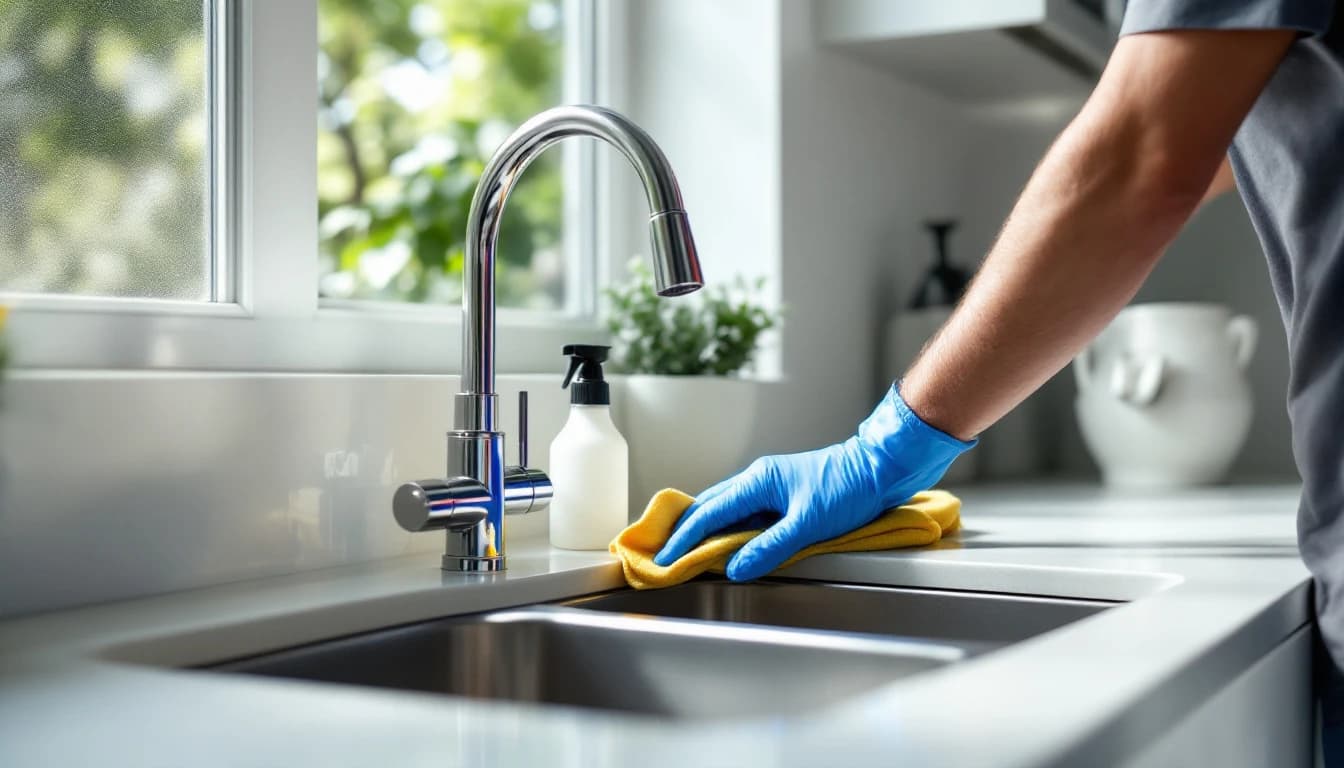
The rest of the block is cabinet fronts and tops (the aerosolized grease film near a cooktop smears rather than lifts under ordinary wiping), the backsplash, hood filter, and wall behind the range, plus counters, sink and faucet descaling, small-appliance exteriors, and the microwave inside and out. Interior refrigerator cleaning is available on request. Our kitchen deep cleaning guide covers that room in more detail than fits here.
The Bathrooms
Bathrooms are the second-longest block and the rooms people judge the whole result by. In Azle they are where the hard water shows.
Shower glass gets descaled rather than wiped, with dwell time and mechanical work, then squeegee-dried so the next round of mineral has nothing to sit in. Chrome fixtures, the spout underside, the shower head, and the drain flange get the same treatment at their own pace, with the product chosen for the finish. The toilet gets descaled at the ring below the waterline, which is where North Texas water leaves its heaviest single deposit, and cleaned at the base, behind, and around the seat hinges — a common odor source people assume is the drain.
Grout gets scrubbed by hand along the lines rather than mopped over. Expect real improvement and hear the ceiling in advance: grout that has absorbed pigment over many years will come up several shades and may not return to white.
Exhaust fan covers come down and get cleaned. This matters more than it sounds. A loaded fan cover moves very little air, and in a humid lake-side bathroom poor extraction is the reason the mildew keeps coming back after you clean it.
Trim, Tracks, and Lake Grit
This is the part Azle customers notice most, because it is the part no routine clean reaches.
Window tracks and sliding-door channels get vacuumed and then wet-detailed into the corners. In homes near the water these fill with a compacted mix of sandy grit, pollen, and insect debris that a vacuum alone will not lift. Door thresholds get the same. Baseboards are washed by hand including the top edge and the profile groove, and door frames get the same attention along the top edge, where grit settles in a visible line.
Ceiling fan blades, light fixture bowls, vent covers, and the tops of door frames all come first in the day, because everything they release lands on surfaces that have not been cleaned yet. Switch plates, door handles, and the wall around light switches get wiped, which sounds minor and changes how a hallway reads more than almost anything else on the list.
How Often a Lake-Adjacent Home Needs This
The honest answer depends on what the house does.
A year-round Azle home on recurring service generally needs a deep clean about every six to twelve months. If a crew is in the house every two weeks holding the line, the buildup accrues slowly and an annual reset is usually enough. Our recurring house cleaning guide for Azle covers how that rhythm works.
A home with no recurring service typically needs one every four to six months, because the descaling items reload continuously and there is nothing between deep cleans to slow them down.
A seasonal or weekend lake house is a different pattern entirely: a deep clean at the start of the season and another at close-up, with lighter service in between. The close-up clean matters more than people expect, since a house that sits shut through a humid stretch with soap film in the showers comes back to a considerably harder job. There is more on that rhythm in our Azle lake-home cleaning guide.
A short-term rental works on turnovers rather than deep cleans, with a full reset scheduled a few times a year between bookings.
What It Costs, and What It Cannot Fix
A deep clean in Azle is $200 to $450, quoted flat before we arrive, supplies and equipment included. We do not quote by the hour. Where you land depends on bedroom and bathroom count, how long it has been since the last deep clean, and how much descaling the bathrooms and kitchen actually need. Two bathrooms with heavy scale is a meaningfully bigger job than two bathrooms without it, and we would rather price that honestly than discover it on the day. For ongoing service after the reset, standard house cleaning runs $120 to $250.
On limits, we will be blunt in advance. Glass etched by years of untreated mineral will be clean and may still look faintly cloudy — the pitting is in the surface. Grout with pigment absorbed into the cement will improve, sometimes dramatically, without necessarily returning to white; going further means sealing or re-grouting. Chrome that has lost its plating under old scale, tile that has lost its glaze, and caulk with mildew grown into it are repair items rather than cleaning items. Caulk in particular is cheap to replace and is the only real fix once mildew is inside it.
A deep clean is also not organizing. Clear surfaces get scrubbed; buried ones get worked around. Twenty minutes of clearing counters before we arrive changes the result more than any product does.
Booking a Deep Clean in Azle
Tell us the bedroom and bathroom count, roughly how long it has been since the last deep clean, whether the home is on city water or a well, and whether the bathrooms have visible scale. That is enough for a firm flat rate, usually without a drawn-out site visit.
We have cleaned Azle and the surrounding DFW communities since 2006. We are fully insured and bonded, and every cleaner is background-checked. Call (682) 201-2909 or email info@lauramaidservices.com for a free, no-obligation quote. The full scope is on our deep cleaning service page, local details are at deep cleaning in Azle, and everything we offer in town is on the Azle services hub. If you want to see how the same problem reads one county west, our Weatherford hard-water deep cleaning guide covers well-water homes in Parker County.
Frequently Asked Questions
How much does a deep clean cost in Azle, TX?
A deep clean in Azle runs $200 to $450, quoted as a flat rate before we arrive with supplies and equipment included. Where you land depends on bedroom and bathroom count, how long it has been since the last deep clean, and how much hard-water descaling the kitchen and bathrooms need. Call (682) 201-2909 for a free quote.
Can you actually remove hard-water buildup, or just clean around it?
We remove it. Scale and soap scum come off with an acidic descaler, proper dwell time, and mechanical work — that is skilled, slow work rather than harder scrubbing. The one exception is etching: if mineral has been left on glass long enough to pit the surface, cleaning takes off everything sitting on top and the glass underneath may still look faintly cloudy. We tell you which one you have before we start.
How often does an Azle home need a deep clean?
A year-round home on recurring service usually needs one every six to twelve months. A home with no recurring service typically needs one every four to six months, because the descaling items reload continuously. Seasonal and weekend lake houses do best with a deep clean at the start of the season and another at close-up.
Why does lake-area dust cause more damage than regular house dust?
The grit that comes in near Eagle Mountain Lake is heavier and more abrasive than ordinary household dust. Instead of floating and settling, it packs into window tracks, sliding-door channels, and door thresholds, and it gets tracked across floors underfoot. That is why track detailing is a standard deep-clean item here and why it takes longer than it would in a landlocked neighborhood.
Do you clean the dishwasher and oven interiors?
Yes, both are standard deep-clean items. The dishwasher gets its filter pulled and cleaned, the interior descaled, and the door seal wiped, which is usually what fixes the smell people blame on the drain. The oven gets racks removed and a treatment with dwell time; an oven that has never been professionally cleaned may need a second pass.
Will a deep clean fix my old grout?
It will improve it, often noticeably, but it may not restore the original color. Grout that has absorbed pigment into the cement over many years is no longer a cleaning problem. We scrub the lines by hand and remove everything sitting on the surface, then tell you honestly where the ceiling is. Going further requires sealing or re-grouting.