
As of August 2026, the real difference between a move-out clean and a deep clean in DFW — occupied vs empty, landlord checklists, deposits, and what each costs
These two services get conflated constantly, and the confusion costs people money in both directions — homeowners paying move-out prices for a job they did not need, and renters booking a deep clean that a property manager then rejects. The distinction is actually simple once you see it. A deep clean is for an occupied home and works around your furniture. A move-out clean is for an empty unit, is graded against someone else's checklist, and includes the inside of every cabinet, drawer, closet, and appliance precisely because nothing is in the way. As of August 2026, this guide covers which one your situation calls for, what each costs, why an empty home is not simply "easier," and when a move-in clean is the right call instead.
The Core Difference: Occupied vs. Empty
Everything else follows from this one fact.
A deep clean happens in a home someone lives in. The furniture stays, the closets are full, the pantry has food in it, and the crew's job is to reach everything a standard maintenance visit does not touch — baseboards, door frames, window tracks, grout, hard-water scale on glass and chrome, ceiling fans, light fixtures, the tops of cabinets, and heavy dust behind and under whatever can reasonably be moved. It is a reset for a lived-in house, usually done once to establish a baseline and then repeated occasionally. It runs $200 to $450.
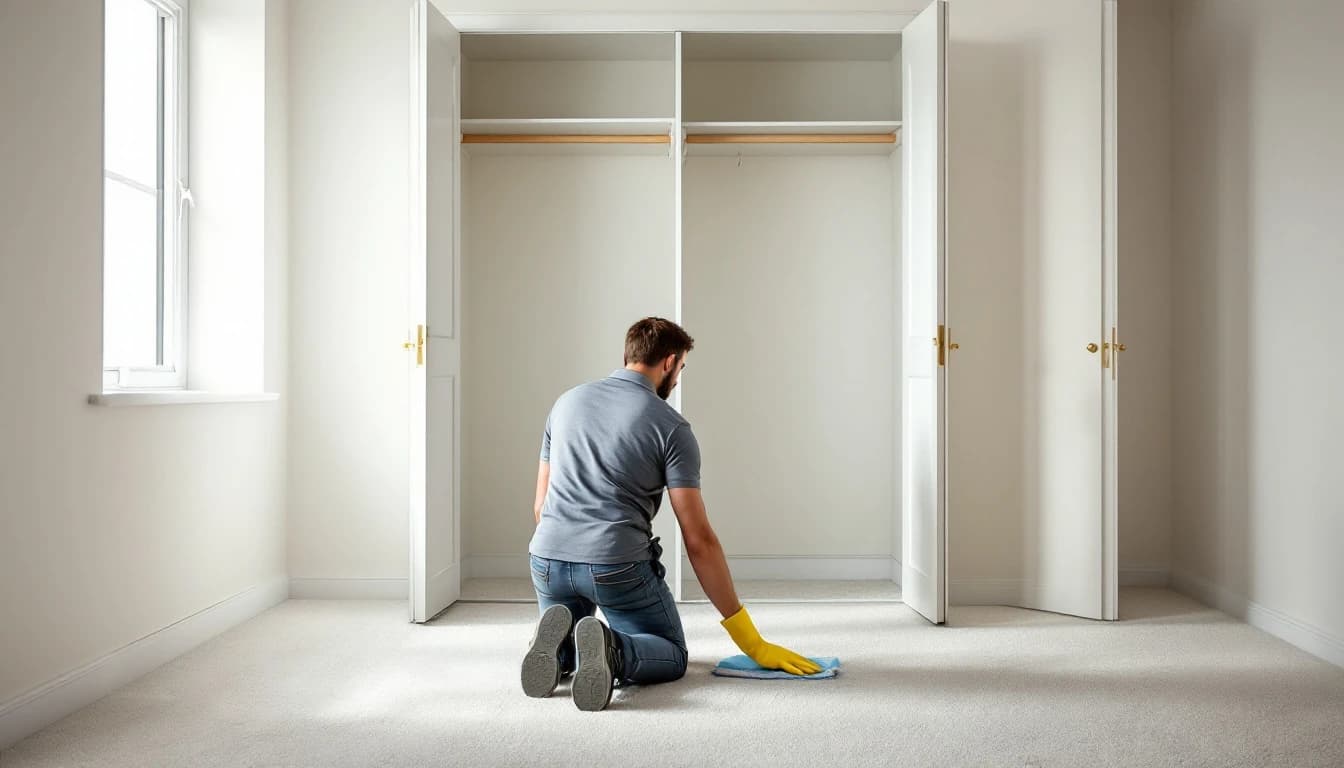
A move-out clean happens after the last box leaves. There is no furniture, so there is nothing to work around and nothing to protect — but also nothing hiding the areas that were never cleaned in five years. Every cabinet and drawer gets cleaned inside. Every closet, including the shelving and the floor and the rod. Inside the oven, inside the refrigerator, behind and under both. Baseboards along every wall, since every wall is now visible. Light fixtures, vents, blinds, and window tracks throughout. It runs $200 to $500, and the reason the top of the range is higher than a deep clean's is scope, not luxury.
The second difference is who judges the result. A deep clean is graded by you. A move-out clean is graded by a landlord, a property manager, or a buyer's final walkthrough — often against a written checklist you did not write and may not have seen.
Side by Side
| Factor | Deep Cleaning | Move-Out Cleaning |
|---|---|---|
| State of the home | Occupied and furnished | Empty |
| Typical price range | $200–$450 | $200–$500 |
| Who judges the result | You | Landlord, property manager, or buyer |
| Inside cabinets and drawers | Not included | Every one, standard |
| Inside closets | Reachable surfaces | Shelving, rod, walls, and floor |
| Inside oven and refrigerator | On request | Standard |
| Behind and under appliances | If accessible | Standard, appliances pulled where safe |
| Baseboards | Detailed where reachable | Every wall, full length |
| Walls and switch plates | Spot-cleaned | Scuff and mark removal expected |
| Typical purpose | Reset a lived-in home | Recover a deposit or close a sale |
| How often | Once or twice a year | Once, at the end of a tenancy |
Why an Empty Home Is Not Automatically Faster
The intuition is that a cleaner runs through an empty house — no furniture to move, no personal items to work around. That is half right, and the other half is where people underestimate the job.
What genuinely goes faster: floors, because there is nothing on them. Vacuuming and mopping an empty house is quick and uninterrupted. Dusting horizontal surfaces is quick because there are barely any. Nobody has to protect belongings or navigate around a sleeping child.
What goes much slower: everything that furniture and possessions were hiding. The inside of thirty kitchen cabinets and drawers is thirty individually wiped surfaces. Every closet has shelving, a rod, corners, and a floor that has never been touched. The wall behind where the couch sat for six years has a dust line. The refrigerator that gets pulled out reveals a floor that was last cleaned when it was installed. The oven that nobody looked inside is now the first thing an inspector opens.
Net effect: an empty three-bedroom is usually a longer job than a deep clean on the same occupied home, not a shorter one. That surprises people, and it is the reason a quote for a move-out clean can come back higher than they expected. It is also why a move-out clean is quoted on the unit's size and condition rather than on square footage alone — a two-bedroom apartment with heavy build-up can outprice a larger, well-kept house.
Which One Does a Landlord Actually Require?
If you are ending a lease, the answer is nearly always the move-out clean, and the reason is the checklist.
Most property managers in DFW work from a standardized move-out inspection form. Those forms are specific in a way general cleaning is not: inside the oven, inside the refrigerator including the drawers, inside all cabinets and drawers, inside the microwave, blinds, window tracks, light fixtures and their covers, vents, baseboards, closet shelving, the washer and dryer connections area, the patio or balcony, and often the garage floor. A deep clean scoped for an occupied home simply does not have most of those items on it, because in an occupied home most of those spaces are full.
Practical advice, in order:
Ask for the checklist before you book. Property managers hand these out; many put them in the lease packet. Give it to your cleaning company and the scope stops being a guess.
Book after the truck is gone, not before. A move-out clean done around remaining boxes is not a move-out clean, and every item that has to be worked around is an item that will fail inspection later.
Confirm what is excluded. Carpet shampooing and steam cleaning are usually a separate specialty service, and many leases require a receipt for it specifically. Exterior windows, wall painting, and repairs are not cleaning. Knowing this ahead of time prevents the "I thought that was included" conversation.
Keep documentation. Photos after the clean and an invoice with the date are the two things that settle a disputed deduction. Deposit disputes are governed by state landlord-tenant law rather than federal rules — the U.S. Department of Housing and Urban Development's renter resources point tenants to their state and local requirements, and in a dispute, dated evidence is what you have.
Our move-out cleaning checklist and cost guide covers the room-by-room list most DFW property managers work from, and the complete move-in and move-out guide walks through both directions of the move.
When You Actually Want a Deep Clean Instead
Plenty of people search "move out cleaning" when a deep clean is the correct service. You want the deep clean if:
- You are staying put. The house is lived in and has drifted — this is a reset, not a handover.
- You are starting recurring service. Most first visits with a new cleaning company should be a deep clean, so the maintenance visits afterward at $120 to $250 have a baseline to hold.
- You are listing the home but still living in it. Pre-listing photography and showings need a furnished home to look its best; the move-out clean comes later, after you have moved out.
- Guests, a holiday, or a season change. A once- or twice-a-year deep clean is the normal cadence for most households.
- Allergy or air-quality reasons. Removing accumulated dust from ceiling fans, vents, blinds, and behind furniture is a deep-clean task in an occupied home. The U.S. Environmental Protection Agency's indoor air quality guidance notes that people spend the large majority of their time indoors, where some pollutant concentrations can run higher than outdoors.
Our deep cleaning service page has the full task list, and if you want to check it against what other companies include, what is included in a deep clean goes item by item.
The Third Option: A Move-In Clean
The most commonly skipped service, and often the one that matters most.
A move-in clean is the same empty-home scope as a move-out clean, performed on the place you are about to occupy rather than the one you are leaving. It runs in the same $200 to $500 band. People skip it because the unit "looks clean" at the walkthrough, and the unit usually does look clean — the previous tenant's move-out clean, if it happened, was graded on appearance by someone with an incentive to sign off.
What a move-in clean gets you is the parts you will otherwise discover later: the inside of cabinets you are about to put dishes in, the inside of the refrigerator and freezer, the shower and tub sanitized before your family uses them, closet shelving before your clothes go on it, and the floors before your furniture covers them. It is also the only realistic window to do it — every one of those tasks becomes harder the moment the truck is unloaded.
If you are moving into an apartment, our move-in apartment checklist covers the sequence. For scheduling, our Arlington move-in and move-out cleaning page and the move-in and move-out service overview have the details, and deep cleaning in Fort Worth covers the occupied-home version.
Getting the Right Quote for Either
Three questions settle which service you need and what it costs: Is the home empty or occupied? Is there a checklist you are being graded against? And how long has it been since it was last cleaned professionally?
From there, a standard clean is $120 to $250, a deep clean is $200 to $450, and a move-in or move-out clean is $200 to $500 — all flat quotes based on the actual space and its condition, never an open-ended hourly meter. Laura Maid Services has served DFW since 2006, is fully insured and bonded, and background-checks every cleaner.
Call (682) 201-2909 or email info@lauramaidservices.com for a straight number with no obligation.
Frequently Asked Questions
What is the difference between a move-out clean and a deep clean?
A deep clean is performed in an occupied, furnished home and reaches what a standard visit does not — baseboards, grout, hard-water scale, ceiling fans, and dust behind reachable furniture. It runs $200 to $450. A move-out clean is performed in an empty unit and includes the inside of every cabinet, drawer, closet, oven, and refrigerator, because nothing is in the way and because a landlord will inspect those exact spaces. It runs $200 to $500 and is graded against someone else's checklist rather than your own judgment.
Will a deep clean satisfy my landlord's move-out inspection?
Usually not, and this is the most expensive misunderstanding in the category. Move-out inspection forms are specific about spaces a deep clean does not cover in an occupied home: inside all cabinets and drawers, inside the refrigerator and oven, closet shelving, blinds, vents, and light fixture covers. Ask your property manager for the checklist before booking, hand it to your cleaning company, and book the clean for after the unit is completely empty.
Is a move-out clean cheaper because the home is empty?
Not usually. Floors and open surfaces go faster with nothing in the way, but everything the furniture and belongings were hiding now becomes billable work — thirty cabinet interiors, every closet shelf, the wall behind the couch, the floor under the refrigerator, and an oven nobody has opened in years. An empty three-bedroom is commonly a longer job than a deep clean on the same home while occupied, which is why move-out cleans are quoted on condition as well as size.
Do I need a move-in clean if the place looks clean already?
It is worth it more often than people expect. A unit that looks clean at the walkthrough was graded on appearance, and appearance does not cover the inside of cabinets you are about to load with dishes, the refrigerator interior, closet shelving, or a shower your family is about to use. A move-in clean runs $200 to $500 and is the only practical window to do that work, because every task becomes harder once furniture is in place.
Does a move-out clean include carpet shampooing?
Typically not — carpet steam cleaning is a separate specialty service with its own equipment, and many leases require a separate receipt for it. A move-out clean covers vacuuming and hard-floor mopping thoroughly, plus the full empty-unit scope. Check your lease for a carpet-cleaning clause before you move out, because it is one of the most common sources of deposit deductions and it is easy to handle when you know about it in advance.
Should my first cleaning with a new company be a deep clean?
For most homes that have not been professionally cleaned in six months or more, yes. A standard clean at $120 to $250 is scoped to maintain a home that is already at a baseline, so running one in a home that is not there means the crew spends the visit on catch-up and the result disappoints. A deep clean at $200 to $450 resets the house once, after which recurring standard visits hold it easily because nothing gets a chance to build back up.