
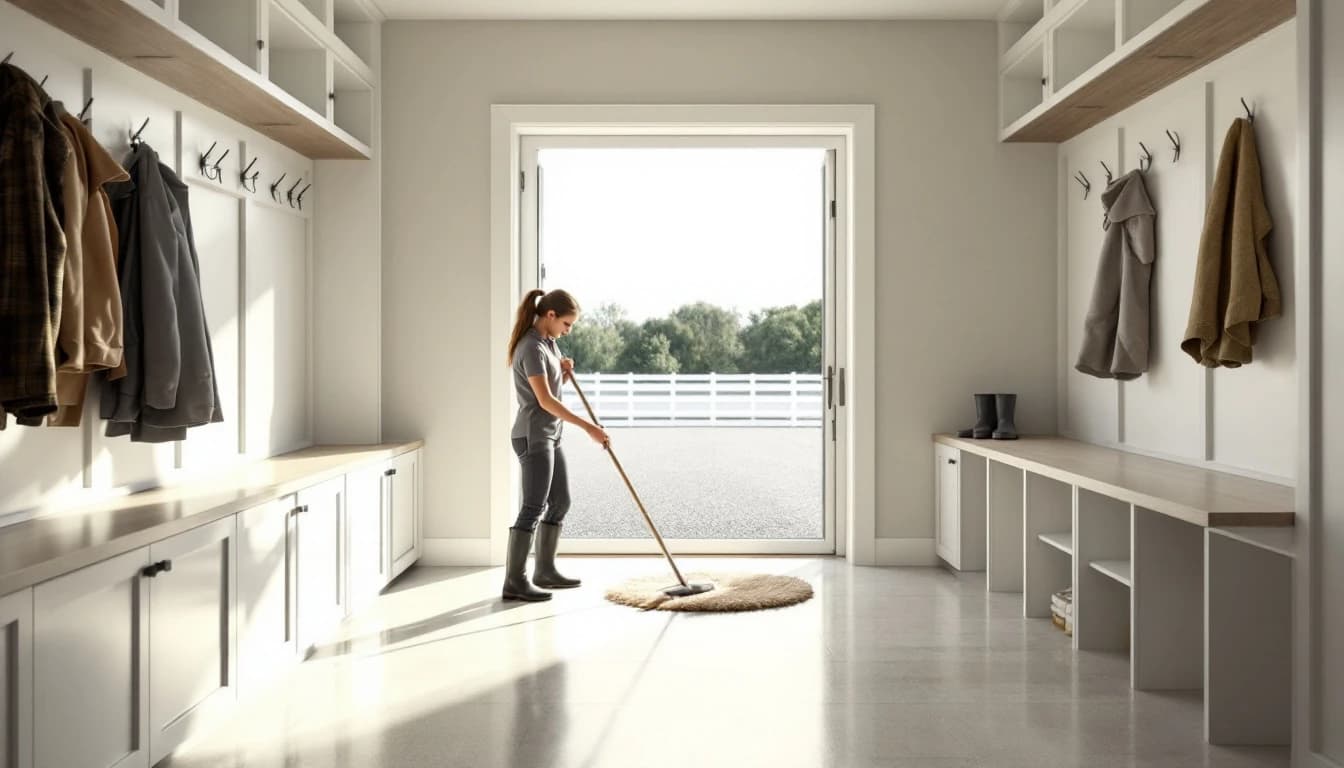
2026 recurring house cleaning in Aledo, TX: why a rotating task plan beats deep cleaning everything, plus mud rooms, gravel dust, dogs and horses.
The most common mistake people make when they set up regular cleaning for a big Aledo house is asking for everything, every time. It sounds like the right instinct. In practice it produces a plan that is either unaffordable or, more often, quietly under-delivered: a crew tries to cover 4,000 square feet plus baseboards plus fans plus windows in one visit, runs out of time somewhere around the third bedroom, and the house ends up with a lot of things half-done and nothing done well.
The plan that actually works on an acreage home is the opposite shape. A fixed core that never gets skipped, and a rotation that moves through the slower-accumulating work a piece at a time, so that the visit stays the same length, the price stays the same number, and no single task is ever badly overdue.
As of September 2026, this guide explains how we build that rotation for Aledo homes, and why the local conditions here — long gravel drives, mud rooms doing real work, dogs and horses, and kitchens that are genuinely large — change which tasks belong in which column. Laura Maid Services has cleaned across Parker and Tarrant counties since 2006, we are fully insured and bonded, and every cleaner is background-checked. Recurring visits run a flat $120 to $250.
Why the Every-Visit Deep Clean Fails Here
Two pieces of arithmetic explain it.
The first is that a large house has more of everything that does not get dirty quickly. Five bedrooms means five sets of baseboards, five ceiling fans, five window sills, and five closet floors, and none of that accumulates measurably faster than it would in a small house. Adding all of it to every visit adds hours of work to solve a problem that does not exist yet.
The second is that the fast-loading work is not evenly distributed either. The kitchen, the mud room and its hallway, the primary bathroom, and whichever room the dogs sleep in carry most of the real load. Those need every-visit attention and enough time to be done properly, which is exactly what gets squeezed when the crew is also doing fans in a guest room nobody has entered since Thanksgiving.
Splitting the work fixes both problems at once, and it holds up in a big house on acreage better than anywhere else.
What the Rotation Actually Looks Like
Here is a four-visit cycle as we would typically build it for an Aledo home on a biweekly schedule. Every visit includes the full core: kitchen surfaces and appliance exteriors, all bathrooms complete, beds made, reachable surfaces dusted with damp microfiber, floors vacuumed and mopped including edges, trash out with fresh liners, and high-touch points wiped. The rotating column is what changes.
| Visit | Rotating focus that visit | Why it sits on that cycle |
|---|---|---|
| 1 | Ceiling fans and light fixtures throughout | Dust-loaded fast by gravel-drive particulate and constant HVAC run time |
| 2 | Baseboards, door frames, and trim in the main traffic path | Where boot dust and dog hair collect first and most visibly |
| 3 | Interior window glass and sills, plus door tracks | Big windows are the point of these houses; grime shows against daylight |
| 4 | Inside the oven or refrigerator, plus vent covers and returns | Kitchen-heavy homes need these on a real schedule, not on request |
That is a starting shape, not a rulebook. If your baseboards are dark and show everything, they move up. If you have a wall of west-facing glass in the living room, that moves up. If the oven is the thing that bothers you every time you open it, we schedule it rather than waiting for you to ask.
The other half of the rotation is under and behind heavy furniture, closet floors, cabinet interiors, upholstery vacuuming, and grout detail, cycling on a longer loop a few times a year. None of it is optional in the long run. It is just correctly spaced, and the difference between a plan that schedules it and one that does not is obvious after about eight months.
Our Kennedale recurring cleaning guide lays out the full every-visit core in detail if you want the complete task list, and our Godley recurring cleaning guide covers how the same structure works on smaller acreage properties south of here.
The Mud Room Is the Whole Ball Game
If we could only do one room well in an Aledo house, this is the one, because it decides how much soil reaches everywhere else.
A working mud room in a home out here is handling boots that have been in a pasture, dog paws, feed dust, gravel from the drive, and in spring a genuine amount of mud. It is a soil interception point, and when it works, the rest of the house stays remarkably clean for a house on acreage. When it stops working — a mat that has gone saturated, a bench with a layer under it that nobody has moved in six months, a floor that gets swept but not mopped — the whole house starts running dirtier and people cannot figure out why.
What that means is specific. Mats get lifted and cleaned underneath rather than vacuumed in place. The floor gets a real mop pass into the corners and along the base of the bench, not a swish down the middle. The bench, the wall behind the hooks, and the trim at boot height get wiped, because that is where the splatter lands. The transition strip into the hallway gets attention, because grit collects there and then rides through the house on socks.
The same logic applies to the garage door and, in a lot of Aledo homes, a back door onto a covered porch that gets used more than the front door ever does. Whichever door people actually come in is the one that needs the work, and it is very often not the one with the wreath on it.
Gravel Drives, Fine Dust, and Damp Microfiber
Long caliche and gravel drives, unpaved parking, arena footing, and the dirt shoulders on the FM roads all put a light mineral dust into the air around these houses. It is not dramatic on any given day, and that is why it fools people. It shows up as a haze on a dark countertop two days after it was wiped, a gray line at the edge of an entry mat, and a visible skim on the tops of door frames and picture frames.
The method matters more than the effort. Dry-dusting lifts that fine particulate into the air, where it settles again on everything nearby including surfaces just finished. Damp microfiber captures it instead. That single difference separates a house that stays clean from one that gets cleaned and still looks dusty by Thursday, and it shows in Parker County more than most places we work.
The same particulate is why ceiling fans, HVAC return grilles, and supply vents sit high on the rotation in these homes. The system pulls dust through the house continuously through a long North Texas summer, and those surfaces load faster than the calendar suggests.
Dogs, Horses, and What Comes Inside With Them
Most of the Aledo homes we clean have at least one dog, plenty have several, and a good number have horses. Animals change a recurring plan in specific ways rather than just making it harder.
Hair goes vertical, not just horizontal. Everyone expects it on floors and furniture. Fewer people expect it in the crevice where carpet meets baseboard, on the sides of upholstered furniture, on the return air grille, and in the corners of the room the dog sleeps in. In a pet-free house those are rotation items. In a pet home they migrate toward the core.
Shedding is seasonal. Spring and fall coat changes produce dramatically more hair than midwinter, and a plan that feels comfortable in January can feel undersized in April. If your visits feel light in one season and overwhelmed in another, that is usually shedding rather than a change in service.
Horse property brings its own load. Hay chaff, shavings, arena dust, and grain dust travel on clothing and boots and end up in the laundry room and mud room first. That is another argument for treating those two rooms as core, high-time work rather than as afterthoughts at the end of a visit.
Odor lives on surfaces, not in the air. Fresheners cover it. What removes it is cleaning where it actually lives: bedding, upholstery, the area around food and water bowls, and the baseboards and corners of the room the animal sleeps in. Our pet owner cleaning guide for DFW goes further on shedding cycles and allergens.
Pet and livestock traffic does move the quote, because it adds real vacuum and surface time. It is priced into the flat rate up front rather than appearing as a surprise later.
Big Kitchens Take Longer Than People Guess
An Aledo kitchen with a large island, a double oven, a range hood over a gas cooktop, and a walk-in pantry is not a scaled-up version of a suburban kitchen. It is a different amount of work, and it is the room where a plan either feels worth the money or does not.
The island is usually the single most-used horizontal surface in the house: homework, mail, groceries, meal prep, and dinner all happen on it. It needs clearing and wiping properly rather than working around whatever is on it. Gas cooktops and their grates hold grease that a wipe does not lift. Range hood surfaces and the wall behind the cooktop collect an aerosol film that builds slowly and then becomes very obvious under good lighting. And the pantry floor in a bulk-buying household collects dust and crumbs nobody sees until something moves.
On a recurring plan the counters, cooktop, sink, appliance exteriors, and floor are core. Grates, the range hood surround, the wall behind the cooktop, inside the oven, inside the refrigerator, and the pantry floor rotate through. That split is what lets a large kitchen stay genuinely clean at a maintenance price. Our kitchen deep cleaning guide covers the heavier version of that work if your kitchen needs a reset first.
The School-Year Rhythm
Aledo runs on the school calendar to an unusual degree, and household cleaning patterns follow it.
From late August through May the house is busiest in short, predictable bursts: mornings, afternoons after practice, and weekends with games and events. Traffic through the mud room roughly doubles, laundry volume goes up, and the kitchen absorbs most of it. That is the stretch where a steady every-two-weeks cadence pays for itself, and where a Thursday or Friday visit is often worth more than a Monday one because it puts the house at its best for the weekend.
Summer flips it. Fewer scheduled trips in and out, more time actually spent in the house, more outdoor activity coming back in through the back door, and often a stretch of travel where nobody is home at all. A lot of Aledo households step down slightly in summer and step back up in August, which is a normal thing to ask for. The one week we would not recommend skipping is the one right before school starts, because that is when the house needs to be reset for a schedule that will not leave room for it later.
What It Costs and How to Start
Recurring visits in Aledo run $120 to $250, quoted flat for your home rather than by the hour. That structure is what makes the rotation possible: paying by time would make adding ceiling fans to a visit visibly cost extra, so most people would decline it.
Square footage, bedroom and bathroom count, animals, and interval set where you land. Bathrooms move the number more than bedrooms because they take longest to do properly, and homes on a shorter interval sit lower per visit. For a fuller breakdown of what drives a residential quote, see how much a house clean costs and our Aledo recurring service guide, and if your home is on real acreage, our Annetta acreage home guide covers the same conditions a few miles west.
Tell us the square footage, bedroom and bathroom count, animals, and how often you want us. We will give you a flat per-visit rate, an honest answer on whether the first visit should be standard or deep, and a rotation built around whatever bothers you most.
Call (682) 201-2909 or email info@lauramaidservices.com. Everything we offer locally is on our Aledo services hub, residential detail is on our Aledo house cleaning page, and the full scope is on our house cleaning service page.
Frequently Asked Questions
Why not just deep clean the whole house every visit?
Because a large house cannot be fully detailed at a maintenance price, and it does not need to be. Five bedrooms means five sets of baseboards, fans, and sills, none of which accumulate faster than they would in a small house. Trying to cover all of it every time means the high-load rooms — kitchen, mud room, bathrooms — get squeezed. A fixed core plus a rotation gives the busy rooms full time every visit and still touches everything else often enough.
How do you decide which tasks rotate and when?
We build the cycle around your house and your priorities. A typical four-visit rotation in Aledo runs fans and light fixtures, then baseboards and trim in the main traffic path, then interior glass and door tracks, then oven or refrigerator interiors and vent covers. Longer-loop items like under heavy furniture, closet floors, and grout cycle through a few times a year. If something specific bothers you, tell us at setup and it moves up permanently.
What does the mud room have to do with the rest of the house?
Almost everything. It is the soil interception point for boots, dog paws, feed dust, and gravel from the drive. When it is working, the rest of an acreage home stays surprisingly clean. When the mat is saturated, the floor is swept but not mopped, and nobody has moved the bench in six months, the whole house starts running dirtier. Mats lifted and cleaned underneath, a real mop pass into the corners, and the wall and trim at boot height are what keep it doing its job.
Do dogs and horses change the price?
Yes, because they add real vacuum and surface time, and it is priced into the flat rate up front rather than showing up later. Hair collects vertically as well as on floors, so baseboards, upholstery sides, and return air grilles move from rotation toward core. Hay chaff, shavings, and arena dust load the mud room and laundry room specifically. Shedding is seasonal, so a plan that feels right in January can feel undersized in April.
Can we go lighter in the summer and heavier during the school year?
Yes, and a number of our Aledo households do exactly that. The school year brings short, predictable bursts of traffic through the mud room and kitchen, which is where a steady biweekly cadence earns its keep, and a Thursday or Friday visit often puts the house at its best for weekend events. Summer is usually lighter and includes travel. The one visit we would not skip is the week before school starts, since that resets the house for a schedule that will not leave room for it later.
How much does recurring house cleaning cost in Aledo, TX?
Recurring visits run $120 to $250 as a flat rate for your home, never hourly. Square footage, bedroom and bathroom count, animals, and interval set where you land, and bathrooms move the number more than bedrooms because they take the longest to do properly. Homes on a shorter interval sit lower per visit. Call (682) 201-2909 with those details and we can quote you on that call.