2026 guide to apartment cleaning services in DFW: what a resident clean covers, how it differs from a house, gate and parking access, cost, and frequency.
Search "apartment cleaning services near me" and you get three completely different businesses on the same results page: companies that clean apartment buildings for property managers, companies that do move-out turnovers between tenants, and companies that clean the apartment you currently live in. Most people typing that phrase want the third one, and it is the one that gets explained the least.
This guide is about that third thing. You live in an apartment somewhere in Dallas-Fort Worth, you want somebody to clean it on a schedule or once before company comes, and you would like to know what that actually covers, what it costs, and what is different about doing it in an apartment instead of a house.
As of September 2026, apartment cleaning falls inside our house cleaning range at $120 to $250 per visit, and most apartments land in the lower half of it. Laura Maid Services has cleaned across DFW since 2006, we are fully insured and bonded, every cleaner is background-checked, and we quote a flat rate rather than an hourly one.
What a Resident Apartment Clean Actually Covers
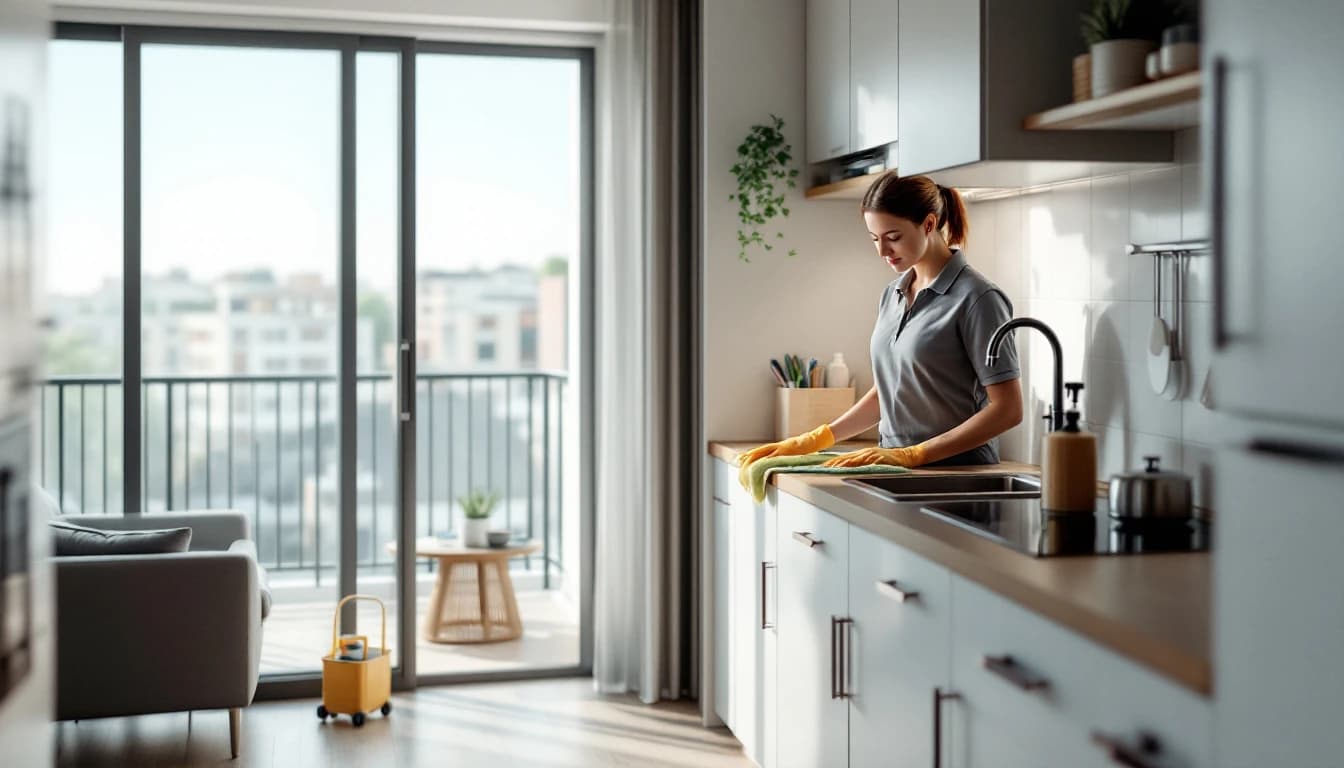
The scope is the same list of rooms a house gets, compressed into fewer of them. In a typical one- or two-bedroom unit that means:
Kitchen. Counters cleared where possible and wiped, sink scrubbed with the faucet and drain done, stovetop degreased, appliance exteriors including the refrigerator door and dishwasher panel, microwave inside and out, cabinet fronts spot-cleaned where hands and splatter land, trash out with a fresh liner, and the floor swept and mopped including the strip in front of the sink where everything collects.
Bathroom or bathrooms. Toilet cleaned inside, outside, and at the base and hinges; tub and shower scrubbed with the glass or curtain track descaled; sink, counter, and mirror done; fixtures polished; floor mopped including behind the toilet; trash emptied.
Bedrooms and living area. Beds made or linens changed if you leave fresh sets out, reachable surfaces dusted, mirrors and interior glass, general tidying of visible clutter into sensible places, floors vacuumed including edges, hard floors mopped.
Throughout. Light switch plates, door handles, the entry area, and a final walk-through.
What it is not: it is not a move-out clean, and the two get confused constantly because both involve an apartment. A move-out is a different job with a different standard — empty unit, inside every cabinet and drawer, inside the oven and refrigerator, blinds, and the appliance pull-outs your lease may specify — and it is priced separately at $200 to $500. If that is what you are actually looking for, our apartment move-in cleaning checklist for DFW covers exactly what that scope includes and what a leasing office looks for. This guide assumes you live there and intend to keep living there.
How an Apartment Is Genuinely Different to Clean
People assume small equals easy. Small is faster, but small also concentrates everything, and a few things about apartments make the work meaningfully different rather than just smaller.
The bathroom does all the work. In a three-bathroom house, load spreads out: guests use one, kids use another, the primary gets the real traffic. In a one-bathroom apartment every shower, every tooth-brushing, every guest, and every hair-drying session happens in the same eight-by-five room. That room gets dirty at a rate that surprises people moving from a house, and it is the room where the difference between a good clean and a fast one is most obvious.
There is nowhere to put things. Cleaning is partly a logistics problem, and apartments have less closet, less pantry, less garage, and no attic. Surfaces stay occupied because there is nowhere else for the items to go, which changes what a cleaner can realistically reach. It also means supplies live somewhere visible if you keep them at all, which is one reason most apartment residents prefer that we bring our own.
Shared walls and shared air. Cooking odors, cigarette smoke, and pet dander move between units through corridors and shared HVAC chases. If your apartment smells like something you did not cook, that is usually the building, not your housekeeping, and no amount of surface cleaning fixes it. What cleaning does fix is the part that is yours: soft surfaces, textiles, and the return air grille, which in apartments is often filthy and almost never mentioned.
Kitchens are small, so grease concentrates. A galley kitchen with a range close to a wall and a weak or recirculating hood puts cooking aerosol onto the wall, the cabinet fronts above the stove, and the underside of the upper cabinets. In a big open kitchen that film spreads thin over a lot of area and stays invisible for years. In an apartment it builds in one small patch and becomes obvious fast.
Floors are usually one continuous surface. Most DFW apartments run vinyl plank or laminate through the living area and kitchen with carpet in the bedrooms. That means the mop pass covers most of the unit and shows every miss, and the transition strips collect grit.
Our condo vs. house cleaning comparison works through more of these differences if you are weighing the two.
Three Apartment-Specific Wrinkles
Laundry, or the absence of it. Some DFW units have a full-size washer and dryer, some have a stacked unit in a closet, and plenty have neither. This matters for a cleaning visit because linen changes only work if there is a way to run laundry, and because in-unit machines create their own cleaning needs: the rubber gasket on a front-loader, the lint area, and the floor of the closet the machines sit in, which collects lint and gets ignored for years. Tell us which setup you have when you book so the visit is planned around it rather than around an assumption.
Balconies and patios. Almost every DFW apartment has one, and it is the single most-skipped area in apartment cleaning. Balcony floors collect a gritty mix of North Texas dust, pollen, and whatever blows off the parking lot, and the sliding-door track between the balcony and the living room is usually the dirtiest three feet in the unit. We handle the door track and the glass as part of a normal visit and can sweep and wipe down a balcony as part of the scope if you tell us it needs it. What we do not do is pressure-wash or handle anything that would send water and debris onto the unit below you, which is both a courtesy problem and often a lease problem.
Storage for supplies. Recurring house cleaning customers often keep a caddy of preferred products in a laundry room. Apartment residents usually cannot spare the space, so the default is that we bring everything. If you have products you specifically want used on a particular surface — a stone counter, a specialty floor finish, something for a sensitivity — leave them out and tell us, and we will use yours instead.
Access Is the Part That Goes Wrong
More apartment appointments get complicated by logistics than by anything about the cleaning itself. Five things worth settling before the first visit.
Gate codes. A large share of DFW complexes are gated, and a code that worked in March may not work in September. If your community rotates codes, tell us when it changes rather than after a crew is sitting at a call box.
Parking. Most complexes have limited or permit-only guest parking, and some tow aggressively. Tell us where a work vehicle can legitimately park. This is a two-minute conversation that prevents a genuinely expensive problem.
Building and elevator access. In a mid-rise or a controlled-access building, a fob or a call-box entry has to be arranged. Some buildings require the resident to be reachable by phone to buzz someone in, which is fine as long as you know that in advance and are not in a meeting at the appointed time.
Entry when you are not home. Options are a key left with us, a lockbox, a smart lock code, or leaving the door unlocked while you are there. Whichever you choose, it should be decided rather than improvised. This is exactly why insured, bonded, and background-checked matters more for apartment work than people assume.
Leasing-office rules. A handful of communities require vendors to check in at the office or ask about insurance. If yours does, tell us and we will handle it.
If it is your first time booking any cleaning service, our guide to how to prepare for a house cleaner covers what to do before we arrive, and what to expect on a first visit walks through the visit itself.
What It Costs and How Often to Book
Apartment cleaning sits inside our house cleaning range of $120 to $250 per visit, quoted as a flat rate. Most apartments land in the lower part of that band, because square footage and bathroom count are the two biggest drivers and apartments are usually modest on both.
What moves you inside the range: bathroom count more than bedroom count, total square footage, pets, whether you want linens changed, and how often we come. Frequency is the lever most people underestimate — a unit cleaned every two weeks never drifts far, so each visit is lighter and the per-visit number sits lower than the same unit cleaned twice a year.
| Apartment | Household | Cadence that usually fits | Where it tends to price |
|---|---|---|---|
| Studio or small one-bedroom | One person | Monthly, or every three weeks | Lower end of the range |
| One-bedroom, one bath | One or two people | Every two to four weeks | Lower half of the range |
| Two-bedroom, one bath | Two people or a roommate pair | Every two weeks | Lower to middle |
| Two-bedroom, two bath | Couple, or two people with pets | Every two weeks | Middle of the range |
| Three-bedroom or townhome-style | Family or three roommates | Every two weeks | Middle to upper |
| Any size, before or after guests | Occasional | One-time visit | Priced as a single clean |
That is a starting map, not a rule. A one-bedroom with two large dogs prices differently from a two-bedroom with nobody in it four nights a week. For the fuller version of how residential pricing works in this market, see our Fort Worth house cleaning cost guide, which breaks down the average cost of house cleaning and what actually moves a quote.
The honest guidance on frequency: in a small footprint, going longer between visits costs you more than it saves. A house can absorb a skipped month across a lot of rooms. An apartment cannot, because the same one bathroom and the same small kitchen are absorbing all of it, and the visit after a long gap stops being maintenance and becomes recovery — which takes longer for the same money and pushes the detail work out.
Where We Clean Apartments in DFW
We work across the Metroplex from 3701 S Cooper St in Arlington, and apartment work is a steady part of what we do — Arlington's large rental stock near the university and the entertainment district, the mid-century and newer complexes across Fort Worth, and the dense rental corridors in the Mid-Cities.
You can start from our apartment cleaning service page for the full scope, or from a city page: Arlington house cleaning, the Fort Worth services hub, Bedford, Euless, or Hurst. The general residential scope is on our house cleaning service page.
Call (682) 201-2909 or email info@lauramaidservices.com with your bedroom and bathroom count, roughly how many people live there, whether you have pets, and how often you want us. That is enough for a flat quote on the call.
Frequently Asked Questions
How much does apartment cleaning cost in DFW?
Apartment cleaning falls inside our house cleaning range of $120 to $250 per visit, and most apartments land in the lower half of that band. We quote a flat rate for your unit rather than charging by the hour. Bathroom count moves the number more than bedroom count, and pets, linen changes, and how often we come all factor in. A unit on a regular schedule prices lower per visit than the same unit cleaned twice a year.
Is apartment cleaning different from a move-out clean?
Yes, completely. A resident clean is maintenance of a lived-in unit: kitchen, bathrooms, bedrooms, living area, floors, and high-touch points. A move-out clean is done on an empty unit to a lease-return standard and includes inside cabinets and drawers, inside the oven and refrigerator, blinds, and whatever else your lease specifies, priced at $200 to $500. If you are moving, that is the service you want, and the two should not be booked interchangeably.
Do you clean the balcony or patio?
We clean the sliding-door track and the glass as part of a normal visit, and we can sweep and wipe down a balcony if you tell us it needs attention. What we will not do is pressure-wash or use enough water to send debris and runoff onto the unit below, since that creates a problem with your neighbor and often violates the lease. Balcony floors and door tracks are the most consistently skipped areas in apartment cleaning, so it is worth asking for.
Do I need to be home, and how do you get in?
Whatever you prefer, as long as it is arranged in advance. Common setups are a key left with us, a lockbox, a smart lock code, or you being home for the visit. Gated communities need a current gate code, controlled-access buildings need a fob or a plan for buzzing the crew in, and some leasing offices ask vendors to check in. We are fully insured and bonded and every cleaner is background-checked, which matters more when someone is entering your home unattended.
Do you bring your own supplies?
Yes, by default, because most apartment residents do not have spare closet space to store a caddy of products. If you have something specific you want used on a particular surface — a stone counter, a specialty floor finish, or a product you use for a sensitivity or allergy — leave it out and tell us, and we will use yours on that surface instead of ours.
How often should I have my apartment cleaned?
For most one- and two-bedroom units with one or two people, every two to four weeks works well. A studio or small one-bedroom with one person can often go monthly. Two bathrooms, pets, or three or more people generally push you to every two weeks. Going longer than a month in a small footprint tends to backfire, because one bathroom and one small kitchen absorb all the load and the next visit turns into recovery rather than maintenance.