
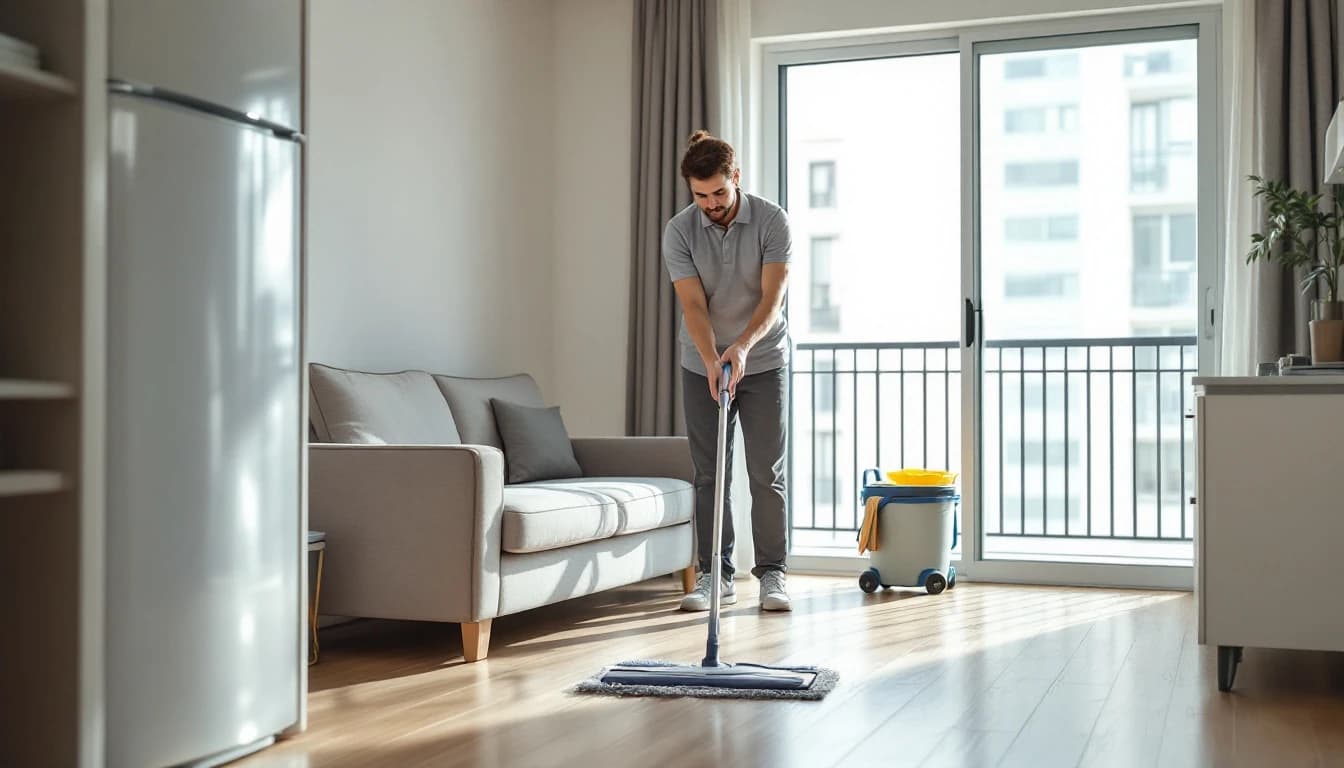
What apartment and condo cleaning costs in DFW by unit size, why bathrooms and floors matter more than square footage, plus move-out pricing.
Renters get quoted badly. Most cleaning price guides are written around single-family homes, and applied to an apartment that logic does one of two unhelpful things: it treats your unit as a shrunken house and quotes far too low, or it quotes a house number because the crew still has to show up, load in, and work a full visit.
Neither is right, because an apartment is not a small house. It has a different ratio of bathrooms to living space, a different floor material, a different kitchen shape, and access problems a detached house does not have. Those things, not square footage, decide how long the job takes and therefore what it costs.
As of September 2026, cleaning an apartment or condo in the Dallas-Fort Worth area falls inside the same $120 to $250 flat-rate band as our house cleaning, with studios and one-bedrooms sitting at the bottom of it and three-bedroom units and rental townhomes sitting well up it. This guide explains where your unit lands and why, what quietly adds time in a rented space, how move-out cleaning prices differently, and what a property manager actually looks at when they walk the unit. If you are still at the stage of choosing a provider, our guide to finding apartment cleaning services near you in DFW covers that side; this one is about the number.
What apartment cleaning actually costs in DFW
The band is $120 to $250 for a standard, maintenance-level clean, quoted flat rather than hourly. Here is roughly how unit types distribute inside it.
| Unit type | What usually drives the number | Where it lands in $120-$250 |
|---|---|---|
| Studio or efficiency | One bath, one open living space, small kitchen | Bottom of the range |
| One bedroom, one bath | Single bath, hard floors throughout, galley kitchen | Bottom to lower middle |
| Two bedroom, one bath | Extra bedroom adds less than a second bath would | Lower middle |
| Two bedroom, two bath | The second bathroom is the real jump, not the bedroom | Middle |
| Three bedroom, two bath | More floor, more glass, two full baths | Upper middle |
| Rental townhome, two stories | Stairs, a second living area, equipment carried up | Upper end |
| Any unit not cleaned in months | Needs a deep clean first to establish a baseline | Moves to $200-$450 |
That last row is the one that catches people out. A standard clean is maintenance work; it assumes the unit is already in reasonable condition and keeps it there. A unit that has gone a long stretch without a professional clean, or one with real buildup in the shower and around the kitchen, needs a deep clean at $200 to $450 once, after which a standard visit maintains it at the lower price. We would rather tell you that on the phone than arrive and try to renegotiate at the door.
The pricing philosophy is the same one we apply to houses, and if you want that logic laid out for a detached home, our guide to what house cleaning costs in Fort Worth works through it in detail. What changes for an apartment is which factors actually move the number.
Why square footage predicts less in an apartment
In a house, square footage is a decent shorthand because space and room count tend to rise together. In an apartment the relationship breaks down, and a 900-square-foot one-bedroom can genuinely take longer than a 1,200-square-foot two-bedroom.
Bathroom count is the strongest single predictor. Bathrooms are the densest labor per square foot in any home: toilet, tub or shower, glass, mirror, sink, counter, fixtures, and floor, all in a space too small to work in efficiently. A two-bed two-bath unit is meaningfully more work than a two-bed one-bath of identical size, and the extra bedroom between them barely registers by comparison.
Floor material is the second. Most DFW apartments built or renovated in the last fifteen years run hard surface through the main living areas — luxury vinyl plank, laminate, or tile. Hard floors have to be swept and then mopped, and they show everything: footprints, pet tracks, water spots near the door, and dust along baseboards that carpet quietly hides. A carpeted unit of the same size is a single vacuum pass, which is why two same-size units can quote differently.
Open plans raise the finish standard. When the kitchen, dining, and living areas are one room, there is no door to close on the part you have already finished, and every surface is visible from every other one. Nothing can be good enough from the doorway.
The things that quietly add time in a rented unit
These are the items renters are surprised to hear about, and they are the honest reason a small unit sometimes prices above what its floor plan suggests.
- Shared-wall and corridor dust. Interior units pull air from a hallway shared with dozens of doors. Dust settles on ledges, blinds, and return-air grilles faster than it does in a detached house, and it is finer.
- Galley kitchens. A narrow kitchen means every appliance front, counter run, and cabinet face is within arm's reach, which sounds fast and is not. There is nowhere to set anything down, and two people cannot work in there at once.
- Tub-shower combos with older grout. The single most time-consuming fixture in most apartments. Grout and caulk in a rental bath have usually absorbed several tenancies of soap film and hard-water scale, and getting them back takes real scrubbing rather than a spray and wipe.
- Balcony doors and tracks. Sliding door tracks collect grit, and the glass is usually the largest pane in the unit. Both are visible, both get skipped by cheap quotes, and both are on the move-out checklist.
- Blinds on every window. Apartments come with them as standard, and they hold more dust than any other surface in the place.
- Appliance surrounds. In rental kitchens the gaps beside and behind the range and refrigerator are narrow and rarely reached, so anything that has gone in there has usually been there a while.
None of that is hidden from you. When we quote, we ask about bathrooms, floor type, and condition precisely so the number we give is the number you pay.
Access is part of the job, and it is fair to ask about it
This is the piece unique to apartment work, and any cleaner who does not ask about it either does not do many apartments or is planning to adjust the price after they arrive.
A crew arriving at a detached house parks in the driveway and walks fifteen feet. A crew arriving at a mid-rise may sit at a gate calling a callbox, circle a garage looking for a visitor space that does not exist, then carry equipment across a lot and up an elevator shared with somebody moving furniture. That consumes a real slice of the visit before a single surface is touched, and on a tight schedule it decides whether the last room gets rushed.
Four things make it painless, and they cost you nothing:
- A working gate code or a call-ahead arrangement, given in advance rather than at the gate.
- A visitor parking answer. If your complex has none, say so — there is usually a loading zone, a guest spot behind the building, or a time-limited space, and knowing about it in advance is worth more than apologizing for it later.
- Elevator or stair reality. A third-floor walk-up with no elevator is a genuine factor when equipment and supplies have to come up and down.
- Key, code, or door handling. Whether we are being let in, using a code, or collecting from a leasing office, and whether the leasing office is actually open at that hour.
Tell us these on the first call and they stop being a problem. Discover them at the gate and they are a problem for everybody, including the customer whose visit is after yours.
Move-out apartment cleaning is its own service
Move-out cleaning is not a standard clean on an empty unit, and it does not price like one. It runs $200 to $500, and the reason is scope: it is a deep clean of an unoccupied unit measured against a landlord's checklist rather than against how a home feels to live in.
An empty unit exposes everything a standard clean never sees: the floor under the bed and behind the couch, the marks where furniture sat, the inside of every cabinet and drawer, the oven and refrigerator interiors and the seals on both, baseboards along an entire wall instead of the visible half, and the light fixtures, vents, and blinds you have not looked at since you moved in.
The stakes are also different. Every other clean is about comfort; this one has your deposit attached to it, and it is judged by a person walking the unit with a form. A townhome or a three-bedroom sits high in the band, a studio near the bottom, and the condition of the kitchen and bathrooms decides most of the rest. Our move-out cleaning checklist covers the room-by-room scope in full, and the move-in and move-out cleaning service page covers how we quote it. Book it for after the unit is empty — a move-out clean done around boxes has to be partly redone.
Recurring or one-time, and why monthly often beats weekly
Renters ask about recurring service and usually assume the answer is weekly, because that is what they have seen advertised for houses. In a one- or two-bedroom apartment, weekly is frequently more service than the space generates.
A small unit with one or two occupants does not accumulate enough between visits to justify a seven-day cycle, and you end up paying for a clean with half a job to do. Every two weeks suits most two-bedroom units, and monthly works well for a studio or one-bedroom with a single occupant. Weekly earns its place when there are pets, roommates, small children, or someone home in the space all day.
Frequency also feeds back into the price. A unit on a standing schedule stays close to baseline and cleans efficiently, which is why recurring visits sit lower in the range than a one-time clean of the same unit. A one-time visit is quoted for the condition we find, and for a unit neglected for a while that is deep-clean territory. Our recurring versus one-time cleaning guide walks through how to choose, and the apartment cleaning service page covers what a standard visit includes.
One practical note for renters specifically: nothing here requires a contract or a long commitment. If your lease is month to month, so is your cleaning schedule.
What a property manager actually inspects
Whether it is a routine inspection, a mid-lease walk, or the move-out walkthrough, the list is more predictable than most tenants expect. In our experience, the items that generate notes are the kitchen appliances inside and out, the condition of tub and shower grout and caulk, toilets, the inside of cabinets and drawers, floor condition at the entry and in front of the sink, balcony door tracks and glass, blinds and window sills, vents and light fixtures, and the bathroom exhaust fan cover.
Almost none of those are things a tenant cleans weekly, which is why a unit that has felt clean for two years can still generate a page of notes on the way out. It is also the argument for a deep clean once during a long tenancy rather than one heroic effort on the last weekend of your lease, when you are also moving.
Getting a flat quote on your unit
Four details get you a real number: bedrooms, bathrooms, floor type through the main living areas, and whether the unit has been cleaned professionally in the past few months. Add the access situation — gate code, parking, elevator or stairs — and we can quote most DFW apartments on the spot inside the ranges above. We quote flat, so the price you are told is the price you pay, and there is no hourly meter running while a crew waits at a callbox.
Laura Maid Services has cleaned apartments, condos, townhomes, and houses across the Dallas-Fort Worth area since 2006, from our base at 3701 S Cooper St in Arlington. We are insured and bonded, and every cleaner is background-checked before entering a unit. If you want the same logic applied to a detached home instead, our house cleaning service page covers that scope.
Call (682) 201-2909 or email info@lauramaidservices.com for a free, no-obligation flat quote on your unit.
Frequently Asked Questions
How much does it cost to clean a one-bedroom apartment in DFW?
A standard clean of a studio or one-bedroom apartment sits at the bottom of our $120 to $250 flat-rate range. The number depends on bathroom count, floor type, and condition rather than on square footage alone. A unit that has not been professionally cleaned in several months usually needs a one-time deep clean first at $200 to $450, after which standard visits maintain it at the lower price.
Why does my apartment cost almost as much as a small house?
Because the work does not scale down the way floor area does. A crew still travels to you, loads in, and cleans a full bathroom and a full kitchen, and those two rooms carry most of the labor in any home. Apartments also add hard-surface floors that show everything, blinds on every window, balcony door tracks, and access time at gates, garages, and elevators that a driveway does not.
Do you need a gate code or visitor parking?
It helps enormously, and it is worth sorting out before the first visit. Give us the gate code or the call-ahead arrangement, tell us where a crew can legally park, and let us know whether the building has an elevator or is a walk-up. Access time is real time, and a few details in advance keep your visit from being rushed at the end.
How much is a move-out clean for an apartment?
Move-out cleaning runs $200 to $500 and is a different service from a standard clean. It covers an empty unit against a landlord's checklist: inside every cabinet and drawer, the oven and refrigerator interiors, baseboards along full walls, blinds, vents, light fixtures, and the floor areas that furniture was covering. Book it after the unit is empty, since a move-out clean done around boxes has to be partly redone.
Should I book weekly, every two weeks, or monthly?
For most two-bedroom units, every two weeks is the right cadence. A studio or one-bedroom with one occupant is often perfectly served monthly, because a small space simply does not accumulate enough between visits to justify a weekly cycle. Weekly makes sense when there are pets, roommates, young children, or someone home in the unit all day.
Do I need a contract for recurring apartment cleaning?
No. Recurring service is a standing schedule, not a commitment, and you can change the frequency or stop at any time. If your lease is month to month, your cleaning schedule can be too. Call (682) 201-2909 with your bedroom and bathroom count and we will quote a flat rate for either a one-time visit or a standing schedule.