As of August 2026, how DFW hosts handle turnover linens and consumables — how many sets per bed, swap vs on-site laundry, and what to restock every turn
Two things decide whether a short-term rental runs smoothly week after week, and neither of them is how hard anyone scrubs. They are linens and consumables — whether there is a clean set ready when the bed is stripped, and whether the toilet paper holds out until the next turn.
As of August 2026, the hosts across DFW who never seem to have a linen emergency are not lucky. They are running enough sets per bed to decouple laundry from the turnover window, they have a written restock list, and their housekeeping partner reports low stock before it runs out instead of after. This guide covers exactly how to set that up, what to buy, who supplies what, and the honest difference between hiring a housekeeper and using a cleaning company for turnovers.
Why Linen Par Stock Is the Whole Game
Here is the constraint everything else follows from: a washer takes as long as a washer takes.
A full wash and dry cycle for sheets is roughly 2 to 2.5 hours on typical residential equipment, and towels are slower because they dry slowly. Your turnover window between a late-morning checkout and a mid-afternoon check-in is realistically about three hours. If the plan is to strip the bed, wash the sheets, dry them, and put them back, you have spent nearly the entire window waiting on a machine — and one heavy comforter or one load that needs a second dry cycle blows the schedule entirely.
The fix is not a faster cleaner. It is par stock: enough clean sets on the shelf that the cleaner strips the bed, makes it with a fresh set from the closet, bags the dirty set, and moves on. Laundry then happens on someone's schedule instead of the guest's.
"Par" is the number of complete sets you keep on hand per bed. Three is the number that works for most DFW properties on a normal cadence:
- One on the bed for the current guest.
- One clean on the shelf ready for the next turn.
- One in the wash or in transit, covering the gap.
Two sets works only if your turnovers are spaced out and you never get a stain. One set is not a system; it is a nightly bet you will eventually lose on a Saturday.
What a Complete Set Actually Means
Hosts routinely buy "three sets of sheets" and still run short, because a set is more than sheets.
Per bed, a complete set is: fitted sheet, flat sheet, one pillowcase per pillow that goes on the bed, and a washable duvet cover or coverlet. The duvet cover is the piece people skip, and it is the piece that matters most — a bare comforter that cannot be washed between guests becomes the thing you cannot honestly say is clean.
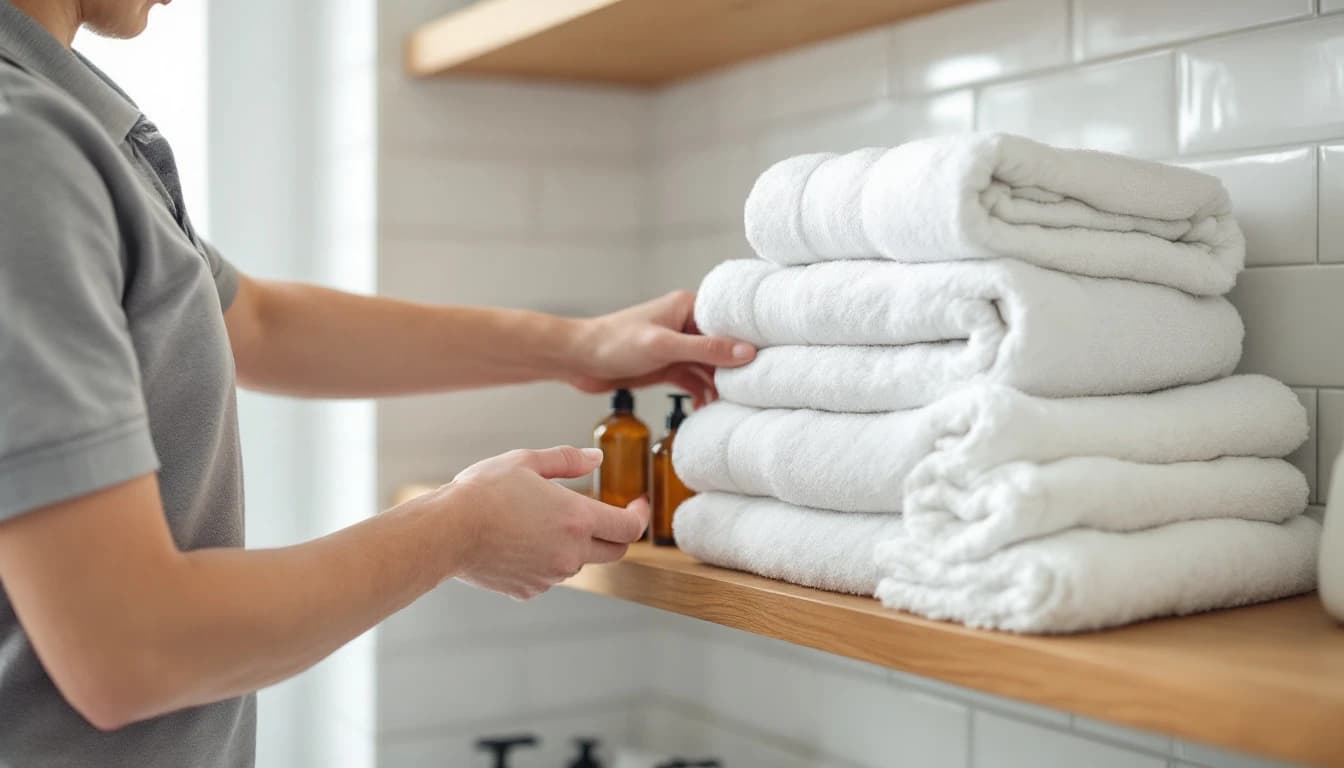
Per bathroom, a complete set is: two bath towels per expected guest in that bathroom, one hand towel, one washcloth per guest, and a bath mat. Kitchen adds dish towels and a dish cloth per turn.
Buy all of it in white, and buy multiples of the same product. This is not an aesthetic preference. White can be washed hot together, bleached when something goes wrong, and replaced piece by piece for years without a color-match problem, and identical sheets from one line mean any piece fits any bed of that size — your closet becomes a pool instead of a set of matched puzzles.
| Unit size | Bed sets to keep | Bath set (per turn) | Restock every turn | Check monthly |
|---|---|---|---|---|
| Studio / 1BR, 1 bath | 3 per bed | 4 bath, 2 hand, 4 cloth, 1 mat | 2 TP rolls, 1 paper towel, soap, trash liners | Bulbs, batteries, spare TP case |
| 2BR, 1 bath | 3 per bed | 6 bath, 2 hand, 6 cloth, 1 mat | 3 TP rolls, 1 paper towel, soap, liners, coffee | Detergent, dish soap, sponges |
| 2BR, 2 bath | 3 per bed | 8 bath, 4 hand, 8 cloth, 2 mats | 4 TP rolls, 2 paper towel, soap ×2, liners, coffee | Bulbs, filters, spare linens |
| 3BR, 2+ bath | 3 per bed | 10 bath, 4 hand, 10 cloth, 2 mats | 6 TP rolls, 2 paper towel, soap ×2, liners, coffee | Full closet audit, stain pull |
| 4BR+ with laundry | 3–4 per bed | 12+ bath, 6 hand, 12 cloth, 3 mats | 8 TP rolls, 3 paper towel, soap ×3, liners, coffee | Full audit, equipment check |
Adjust to your booking pattern. A property doing four turns a month can live at the low end; one doing twelve, with back-to-back weekends, wants the higher count — and the extra set costs less than one bad review about damp towels.
Swapped Sets Versus On-Site Laundry
There are three workable models, and the right one depends on your volume and your equipment.
Swap and wash off-site. Cleaner brings clean sets, takes dirty sets away, launders them elsewhere, returns them next visit. Fastest turnovers by a wide margin, and it removes the washer from the critical path entirely. It requires the most par stock and a clear agreement about who owns the linens and what happens if a piece goes missing.
On-site laundry, washed during the turn. Cleaner starts the first load in the first five minutes and folds between other tasks. Works well for one-bedroom units and for properties with a full-size washer and dryer rather than a stacked apartment unit. On a three-bedroom, it is the reason turnovers run late.
On-site laundry, washed on a gap day. If your calendar has natural gaps, everything gets washed then and the turnover is pure cleaning. Cheapest good option when it fits.
Most DFW hosts land on a hybrid: enough par stock to make the bed immediately from the closet, plus an on-site machine running during the turn to refill it for next time. That gets you speed without the cost of full off-site linen service.
Whichever model you pick, write down who buys replacements. Linens are consumable — they wear out, they stain, they occasionally leave with a guest. That job works best sitting with you, prompted by your cleaner's reports.
Catching a Stained or Worn Linen Before Your Guest Does
This is the quiet job of a good turnover, and it is entirely about inspection discipline.
Every piece coming off a bed gets looked at in decent light before it goes into the bag, and every piece coming out of the closet gets looked at before it goes on the bed. What you are looking for: makeup and self-tanner on pillowcases (the most common by far), coffee and wine, sunscreen on towels, pilling on sheets that have been washed many times, thinning at the center of bath towels, and frayed hems.
The rule that keeps a property looking good: if you would not want to sleep on it, retire it, do not re-shelve it. A stained pillowcase does not become acceptable because it is clean. Retire it to a rag bin or a cleaning-cloth pile and pull a replacement from spare stock.
Two North Texas specifics worth knowing. Hard water across much of the Metroplex leaves minerals in fabric that make towels feel stiff and gray over time, and it shortens the visible life of white linens noticeably. And in cedar season through winter and ragweed in the fall, linens stored in an open closet pick up dust — a closed cabinet or lidded bin keeps your backup set actually fresh. If you want general guidance on indoor air and dust, the EPA's indoor air quality resources are a reasonable starting point.
Keep a small spare stock beyond your par count — one extra set of sheets and a few extra towels per property. That is what turns "a pillowcase got stained" into a non-event rather than a supply run at noon.
The Restock List and Who Supplies What
Restocking fails for one reason: nobody wrote the list down, so it lives in someone's head and gets forgotten on the busy day.
A workable list for a DFW rental, restocked every turn: toilet paper (one full spare visible per bathroom, minimum), paper towels, hand soap at every sink, dish soap, dishwasher pods, trash liners for every bin, coffee and filters if you offer them, and body soap or shampoo if that is part of your setup. Checked monthly rather than per turn: light bulbs, batteries for locks and remotes, HVAC filters, sponges, and cleaning supplies in the owner's closet.
On supply, the arrangement that works is straightforward. You supply the consumables and the linens; your cleaner supplies the cleaning products and equipment. That is the standard division for a reason — you control the brands your guests see, you buy in bulk at your own cost, and the cleaning company brings professional-grade products it already knows how to use safely on your surfaces.
That means the owner's closet needs to exist as a real, stocked, accessible place. A labeled shelf or bin with a month of consumables in it. A cleaner who has to hunt for toilet paper is a cleaner burning minutes you are paying for.
Then the part most hosts skip: the low-stock report. Your cleaner sees your closet every single turn and is the only person who knows what is running out. That should come to you in writing at the end of each turnover, along with the ready confirmation and photos — "two rolls of TP left, down to one clean bath towel set, kitchen sponge needs replacing." A host who gets that message every turn never runs out of anything. A host who does not gets a guest message about it instead.
Housekeeper Versus Cleaning Company: The Honest Version
Hosts search for an "Airbnb housekeeper" and an "Airbnb cleaning service" interchangeably, but they describe different arrangements, and the trade-offs are real.
An individual housekeeper is one person you hire directly. Upsides: continuity — the same person learns your property, your closet, and your standards, and you build a relationship. Often lower cost per turn. Downsides that matter: no coverage when they are sick, on vacation, or double-booked on the exact Saturday you need most; you are usually responsible for insurance exposure and worker classification questions; and there is no second person for a large property or a same-day double.
A cleaning company puts a team behind the job. Upsides: coverage when someone is out, two cleaners on a property that needs two, insurance and bonding carried by the business, background checks run as policy, and a documented scope so the standard does not drift. Downsides: usually a bit more per turn, and it takes deliberate effort to get crew consistency rather than a rotating team — so ask about that directly.
The honest recommendation: if you run one small unit with a relaxed calendar and you have found someone reliable, an individual housekeeper can be an excellent arrangement. If you run multiple units, tight same-day windows, or peak-weekend volume where a no-show costs you a booking, the redundancy is worth paying for. Our comparison of an Airbnb cleaning company versus an independent cleaner lays out that decision in more detail, and what to look for when hiring an Airbnb cleaner covers the vetting questions for either route.
Whichever you choose, hold the same standard: insured, bonded, background-checked, a written scope, and a report at the end of every turn. Our turnover standards and cost guide sets out what that scope should contain.
Getting Your Linen and Restock System Set Up
Turnovers across DFW run $80 to $200, quoted flat by unit size and scope, and linen handling is part of what we scope when we quote — swap, on-site wash, or hybrid, with the restock list agreed in writing before the first turn.
Laura Maid Services has cleaned DFW properties since 2006 from our Arlington office at 3701 S Cooper St. We are insured and bonded and every cleaner is background-checked.
Call (682) 201-2909 or email info@lauramaidservices.com with your bed and bath count, your laundry setup, and how many turns a month you run. See the Airbnb cleaning service page for full scope, or start local with Fort Worth Airbnb cleaning, Granbury Airbnb cleaning — lake rentals have their own linen pattern, covered in our Granbury lake rental guide — or the Laura Maid Services home page.
Frequently Asked Questions
How many sets of sheets does an Airbnb need per bed?
Three complete sets per bed is the number that works for most properties: one on the bed, one clean on the shelf, and one in the wash. Two sets only holds up if your turnovers are well spaced and nothing ever gets stained. A complete set means fitted sheet, flat sheet, a pillowcase for every pillow on the bed, and a washable duvet cover — the duvet cover is the piece hosts most often forget to duplicate.
Should linens be washed on-site or swapped out?
Swapping fresh sets from a stocked closet is always faster, because a wash and dry cycle runs roughly 2 to 2.5 hours against a turnover window of about three. The common approach is a hybrid: the bed is made immediately from par stock, and the on-site machine runs during the turn to refill the closet for next time. Pure on-site washing works for a one-bedroom and causes late finishes on a three-bedroom.
Who supplies the linens and consumables — the host or the cleaner?
The standard split is that the host supplies linens and consumables and the cleaning company supplies cleaning products and equipment. You control the brands guests see and buy them in bulk at your own cost; the company brings professional products it knows are safe on your surfaces. Keep everything in a labeled owner's closet so nobody spends paid minutes hunting for toilet paper.
How do I stop guests finding stained or worn towels?
Inspect in both directions: every piece is checked in good light coming off the bed and again coming out of the closet. If you would not want to sleep on it or dry off with it, retire it rather than re-shelving it. Buy all-white linens so you can wash hot, bleach, and replace individual pieces, and keep one spare set beyond your par count so a retirement never becomes a supply run.
What should be restocked on every single turnover?
Toilet paper with at least one visible spare per bathroom, paper towels, hand soap at every sink, dish soap, dishwasher pods, trash liners for every bin, and coffee and filters if you offer them. Light bulbs, lock and remote batteries, HVAC filters, and sponges are monthly checks rather than per-turn items. Your cleaner should send a low-stock note at the end of each turn so you replenish before anything runs out.
Is an individual housekeeper better than a cleaning service for a short-term rental?
It depends on your volume and your tolerance for a no-show. An individual gives you continuity and often costs less per turn, which suits a single unit on a relaxed calendar. A company gives you coverage when someone is out, a second cleaner for large properties, and company-carried insurance, bonding, and background checks — which matters most when a missed Saturday turnover costs you a booking. Hold both to the same standard: written scope and a report after every turn.