2026 guide to Airbnb turnover cleaning service across DFW: flat $80-$200 per turnover, what a turn covers, same-day windows, linens, restocking and reporting
An Airbnb turnover cleaning service in DFW costs $80 to $200 as a flat rate per turnover, quoted by unit size before the first turn rather than billed by the hour. That price covers a complete guest-ready reset: beds stripped and remade with fresh linens, bathrooms detailed, kitchen degreased and emptied, floors vacuumed and mopped, trash removed, high-touch surfaces disinfected, consumables restocked from your supply, and the space staged to match your listing photos.
As of July 2026, short-term rental hosts across Tarrant, Johnson, Parker, and Hood counties are running tighter calendars than ever, and the cleaning slot is the single most fragile link in the chain. This is the metro-wide guide to how a professional turnover actually works: what it includes, how the checkout-to-checkin window really gets scheduled, who supplies what, and why flat per-turnover pricing is the only structure that lets you model your margin honestly.
What a Turnover Includes That a Regular House Clean Does Not
Hosts often start by calling a residential cleaning company and asking for "just a normal clean." The scope mismatch shows up on the first review.
A regular house cleaning maintains a space for the people who already live in it. Beds get straightened, not stripped. The refrigerator is left alone because the family knows what is in it. Personal items stay where they are. Supplies are the homeowner's problem. That is exactly right for a home and exactly wrong for a rental.
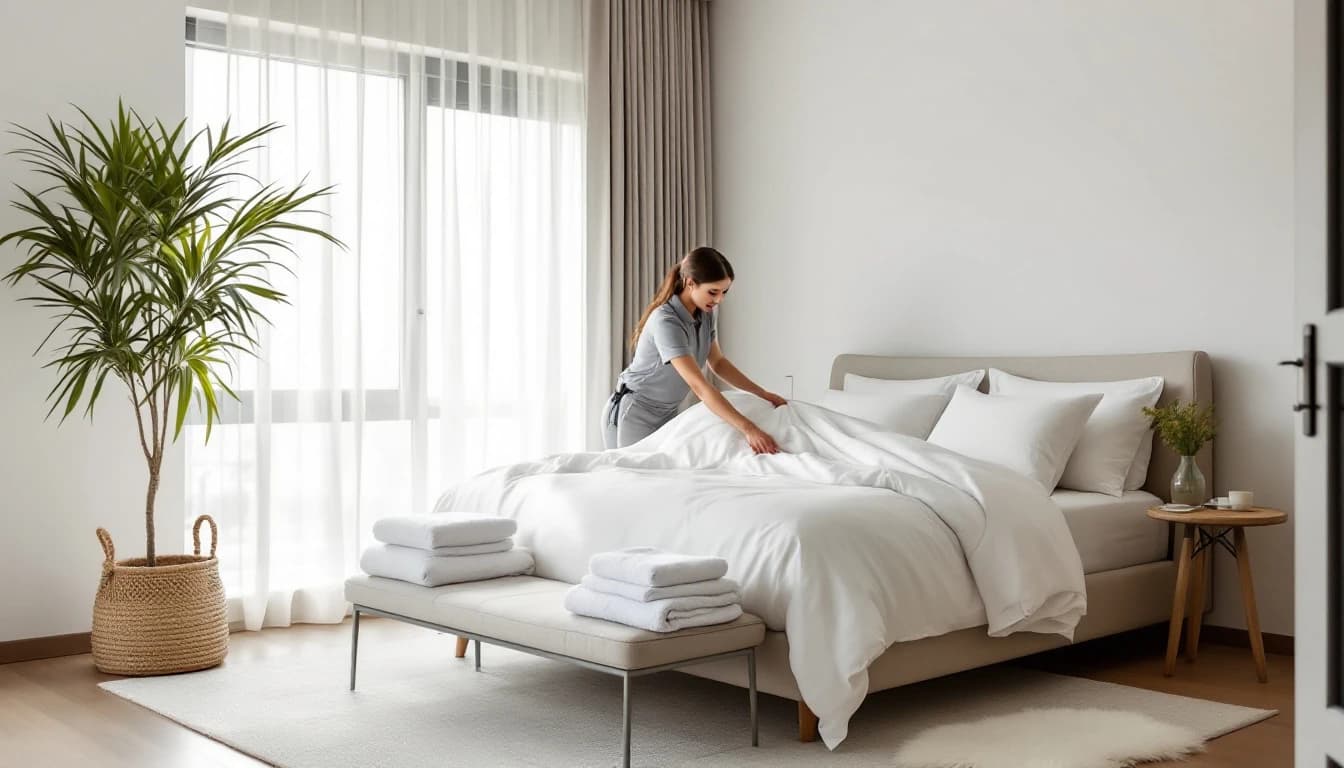
A turnover resets the property to a hotel-grade first impression for a stranger who will form an opinion in the first ninety seconds and then publish it. Every bed is stripped to the mattress protector and remade with a laundered set. The refrigerator and freezer are emptied of everything a guest left behind, including the half bottle of dressing in the door. Every closet, drawer, and under-bed space is checked for forgotten belongings. Consumables are counted and topped up. And the last five minutes of the visit are spent staging, not cleaning: curtains opened, pillows squared, thermostat set for arrival, lights checked.
There is one more difference that nobody mentions in the listing description. A turnover cleaner is also your inspector. They are the only person who sees the property between every single guest, which makes them your early-warning system for damage, wear, and slow leaks that would otherwise surface as a bad review or a five-figure repair.
The Checkout-to-Checkin Window and How Scheduling Really Works
The standard short-term rental window is an 11 a.m. checkout and a 3 or 4 p.m. checkin. That looks like four or five hours of runway. In practice it is often three.
Guests leave late. A 15-minute grace turns into 40. Travel between properties in a metro this spread out eats real time, especially anything crossing I-30 or I-35W in the middle of the day. And a turn cannot start until the property is genuinely empty, which means the clock does not begin when your listing says it does.
Professional turnover scheduling handles this in three ways. First, the turn is built around your actual checkout and checkin times, not slotted into a generic route. Second, the checklist runs in the same order every time so that when the window compresses, the work that has already happened is always the guest-visible work: beds, bathrooms, kitchen. Third, you get a confirmation when the property is reset, so you can release the listing status or message the incoming guest with confidence rather than guessing.
Where hosts get burned is the unannounced back-to-back. A same-day turn booked at 9 a.m. for a 3 p.m. checkin is possible but it is not automatic, and any company that promises it unconditionally is either overpromising or planning to cut the clean short. The honest answer is that same-day turns work reliably when they are on the calendar in advance, and they work often but not always when they appear that morning. Hosts who share their booking calendar rather than calling turn by turn get a materially better hit rate.
Linens, Laundry, and What Hosts Must Supply
Linens are the most common source of turnover confusion, and the answer is simpler than most hosts expect: you supply, the cleaner handles.
The setup that works at every property size is at least two complete linen sets per bed and three towel sets per bathroom, stored on-site. During the turn, the used set comes off, a fresh set goes on, and the dirty set either goes into the on-site washer or gets bagged for the next cycle. That way the bed is made with linens that are already clean and dry, and nobody is standing around at 2 p.m. waiting for a dryer to finish while your guest is fifteen minutes out.
If a property has no washer or dryer, the realistic options are a larger on-site stock of sets rotated through an off-site laundry, or a linen service. What does not work is a single set per bed and a hope that the dryer cycle finishes before checkin. That is the setup that produces damp sheets, and damp sheets produce the review every host dreads.
Hosts also supply cleaning consumables, trash bags, and the guest amenities they advertise. A small locked supply closet or a labeled cabinet keeps everything in one place so the turn does not stall on a hunt for toilet paper. For a fuller walkthrough of the host-side setup, our guide for Fort Worth property owners covers the closet build in detail.
Restocking Consumables Without Surprise Charges
Restocking sounds trivial until a guest runs out of toilet paper at 11 p.m. and leaves a three-star cleanliness review about it the next morning.
The consumables worth tracking on every single turn are toilet paper, paper towels, hand soap, dish soap or dishwasher pods, trash bags, coffee and filters, and anything your listing explicitly promises. The rule we work by is straightforward: we restock what you have supplied and stated, we leave a visible spare where it matters, and we tell you when a category is running low so you can top up the closet before it becomes a problem. We do not buy supplies on your behalf and add them to the invoice, and we do not decide unilaterally that your listing needs something you never mentioned.
That boundary matters more than it sounds. Surprise line items are the fastest way to destroy a host's cost model, and a host who cannot predict cleaning cost cannot price a nightly rate with confidence.
Damage and Missing-Item Reporting
Your cleaner is in the property before you are and before the next guest is. That makes turnover reporting a real part of the service, not a courtesy.
The practical standard is: photograph it, report it same day, do not touch it. A broken lamp, a stained duvet, a cigarette burn, a missing remote, a wall scuff that was not there last week, a shower door that no longer latches. Sending you a photo with a timestamp while the property is still empty gives you a clean, defensible record if you need to open a claim, and it gives you the chance to swap the item before the incoming guest ever sees it.
The same applies in reverse for guest belongings. Phone chargers, retainers, jewelry, kids' toys, and prescription bottles turn up constantly. The right handling is to bag it, label it with the checkout date, set it somewhere consistent, and message you, so that when the guest reaches out two days later you can answer immediately instead of guessing.
The Overlooked Items That Decide Your Cleanliness Rating
Cleanliness scores are rarely lost on the obvious. Nobody forgets the toilet. Ratings die on the specific, findable details that signal to a guest that the clean was rushed, because once a guest finds one, they go looking for more.
Under the beds. The first place a parent looks when a toddler drops something, and the last place a rushed cleaner goes. Socks, wrappers, and dust bunnies live there.
Inside the microwave. Guests open it within an hour of arrival. A splattered interior is the single most quoted detail in bad cleanliness reviews.
Shower door tracks and the drain. Standing water, soap scum, and hair in the track are visible from standing height and read as neglect even when the rest of the bathroom is spotless.
Remote controls. Sticky, greasy, and handled by every guest who has ever stayed. They need an actual disinfecting wipe, not a pass with a dry cloth.
Patio furniture and outdoor seating. In North Texas, pollen and dust cover an outdoor table in a matter of days. A guest who paid for a patio and found it filmed over will say so.
Add the underside of the toilet seat, the inside of the coffee maker reservoir, the top of the refrigerator, baseboards in the entry, and the inside of the washer drum, and you have covered most of what separates a 4.6 cleanliness rating from a 4.9. The U.S. Environmental Protection Agency's indoor air quality guidance makes a related point that hosts underrate: spaces with frequent occupant turnover benefit disproportionately from thorough high-touch cleaning and ventilation, which is why a turn that opens windows and wipes switch plates smells different on arrival.
Consistency Across a Portfolio
One property is a task. Four properties is a system, and systems break in ways that single tasks do not.
The failure mode is drift. Property A gets the full checklist because it was the original listing and everyone remembers its quirks. Property D, added last spring, gets whoever is available and a vague briefing. Six weeks later Property D's cleanliness rating is two-tenths lower and nobody can say exactly why.
The fix is boring and effective: one written checklist per property, one team that cleans them on a standing schedule, and a photo confirmation on each turn. When the same crew handles your portfolio, they learn that the second bathroom at one address has a slow drain, that another address needs the patio hosed in pollen season, and that the guest bedroom closet at a third holds the spare linens. That institutional memory is not a nice-to-have; it is the entire reason a portfolio can grow without the cleanliness score sliding.
Why Flat Per-Turnover Pricing Beats Hourly for Hosts
Hourly pricing transfers all the risk to you. If the last guest was hard on the property, your cost goes up on exactly the turn where your revenue did not. If a cleaner is slow, you pay for slow. And you cannot put an hourly rate into a margin model, because you do not know the hours until after they happen.
A flat per-turnover quote inverts that. The scope is fixed, the price is fixed, and a heavy turn is the cleaner's problem to absorb rather than a surprise on your invoice. Twelve turns in a month costs exactly twelve times a number you already know.
| Unit Size | Typical Turnover Scope | Where It Lands in the $80 - $200 Range |
|---|---|---|
| Studio / 1-bedroom | Full reset, one bath, linens, kitchen, staging | Bottom of the range |
| 2-bedroom | Full reset, up to two baths, linens, kitchen, staging | Lower-middle |
| 3-bedroom | Multiple beds and baths, linens, kitchen, staging | Middle to upper |
| 4+ bedroom or multi-level | Custom-scoped turn with extra staging and outdoor areas | Top of the range |
Every Laura Maid Services turnover falls in the $80 to $200 range, quoted before the first turn. Hosts who want a periodic reset beyond the routine turn can layer in a deep cleaning at $200 to $450, which is worth scheduling seasonally on any listing that books heavily.
Where We Cover Turnovers Across DFW
Turnover demand looks different in every corner of the metro, and the city guides go deeper on what each market does to a property.
- Fort Worth turnovers for Stockyards, downtown, and TCU-area listings
- Arlington turnovers for the event-driven stadium and Six Flags market
- Mansfield turnovers for large family homes and tournament weekends
- Weatherford turnovers for Parker County getaways and hard-water properties
- Granbury lake rentals for waterfront and dock-side listings
- Azle lake rentals for Eagle Mountain Lake properties
Whichever market your listing sits in, the Airbnb cleaning service hub is where scheduling, scope, and flat quoting get set up.
Frequently Asked Questions
How much does an Airbnb turnover cleaning service cost in DFW?
Turnovers are quoted as a flat rate from $80 to $200 per turn, based on unit size and scope. A studio or one-bedroom sits at the low end, while a four-bedroom or multi-level property with outdoor areas reaches the top. Because it is a flat quote rather than an hourly rate, you can build the exact number into your nightly pricing before you accept a booking.
What is the difference between a turnover and a regular house clean?
A regular house clean maintains a home for the people living in it, so beds are straightened rather than stripped and personal items stay put. A turnover strips and remakes every bed with fresh linens, empties the refrigerator, checks for left-behind belongings, restocks consumables, reports damage, and stages the property to match your listing photos. The turnover is closer in intensity to a deep clean but runs on a hard checkout-to-checkin deadline.
Do you supply the linens and towels, or does the host?
Hosts supply linens, towels, and consumables; we handle the labor. The setup that works best is at least two complete linen sets per bed and three towel sets per bathroom kept on-site, so the bed is always made with a set that is already clean and dry rather than one still in the dryer.
Can you handle a same-day turnover between guests?
Yes, and same-day turns are routine when they are on the calendar in advance. A turn that appears the same morning is often possible but never guaranteed, because it depends on crew availability that day. Sharing your booking calendar rather than calling turn by turn dramatically improves the hit rate on tight windows.
What happens if a guest damages something or leaves an item behind?
Damage is photographed and reported to you the same day without being disturbed, which gives you a timestamped record if you need to file a claim and a chance to swap the item before the next guest arrives. Belongings left behind are bagged, labeled with the checkout date, and stored in a consistent spot so you can answer the guest immediately when they reach out.
Is a flat quote still possible if my property is unusually large?
Yes. Larger and multi-level properties are scoped in advance so the flat rate reflects the real bedroom, bathroom, and outdoor count, and the top of the $80 to $200 range covers four-bedroom-plus listings. Scoping happens once, before the first turn, so the number stays stable across the season.
To set up flat-rate turnover cleaning for your DFW short-term rental, call Laura Maid Services at (682) 201-2909 for a per-turnover quote by unit size.