
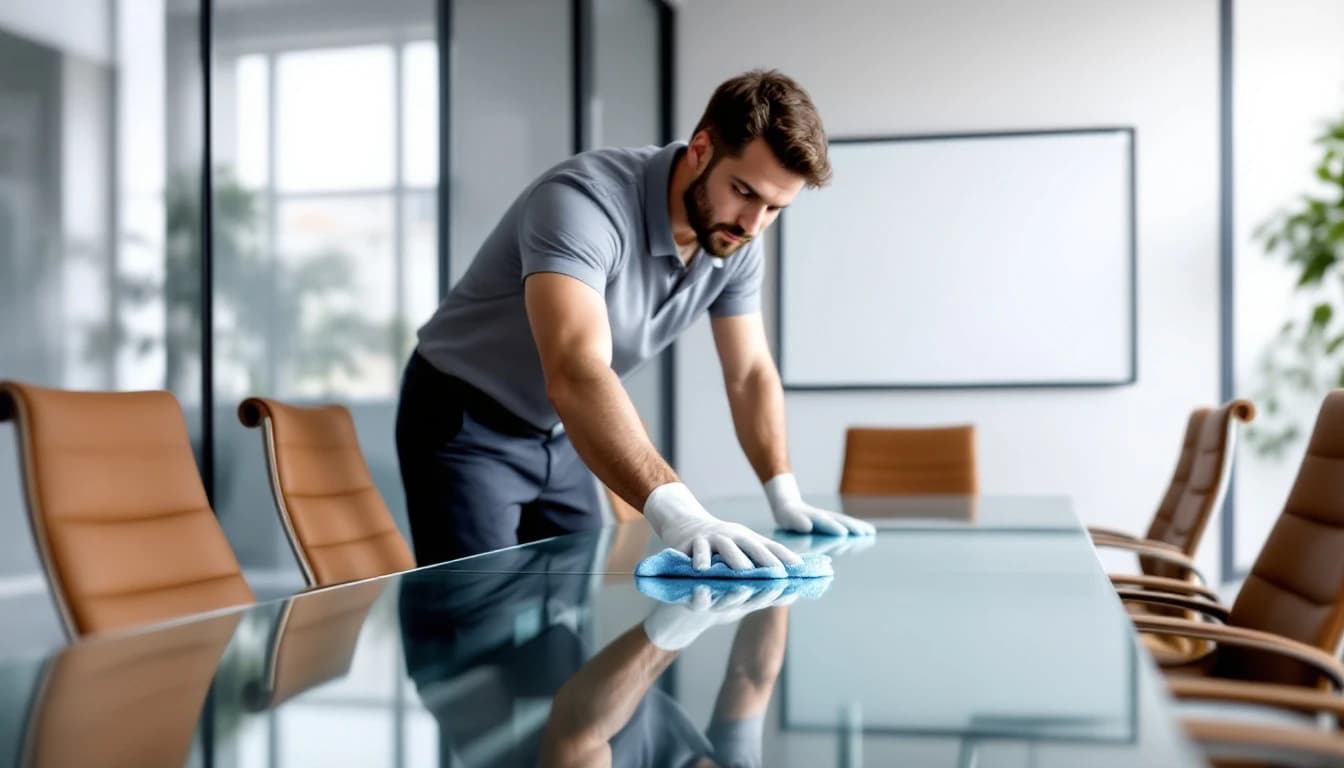
2026 Hurst office cleaning guide — flat $150 to $400 per visit, multi-tenant suite realities, after-hours key and alarm handling, and waiting-room standards
Hurst is a suite city. Drive the Highway 26 and 121 corridor, or the streets feeding North East Mall, and what you see is not campuses and towers — it is professional buildings carved into eight, twelve, or twenty small tenant spaces, plus strip-center storefronts converted into dental practices, insurance agencies, title companies, chiropractic and physical-therapy clinics, and one-attorney law offices. That building type creates a specific set of cleaning problems that a plan written for a standalone office does not solve.
As of August 2026, professional office cleaning in Hurst runs a flat $150 to $400 per visit. Laura Maid Services has cleaned commercial space across Northeast Tarrant County since 2003, and we quote that number before the work starts rather than after a sales walkthrough. This guide covers what moves your quote inside that range, what multi-tenant buildings do to a cleaning plan, how after-hours access and alarm handling should be set up, and why a patient-facing waiting room deserves its own standard.
What a Hurst office cleaning quote is actually measuring
Two suites of identical square footage in the same Hurst building routinely quote a hundred dollars apart. The variables are consistent.
Restroom count and whether it is yours. In a multi-tenant building, this is the first question. A private in-suite restroom is a manageable stop. A restroom block in a shared corridor used by four tenants and their visitors is a different job entirely — higher volume, more dispensers, more floor, and a standard that has to hold up to people who are not your employees. Count restrooms before you count offices, and be clear about which ones are in your scope.
Occupancy density. Twelve people working in an open plan generate more trash, more desk dust, more keyboard and phone touchpoints, and far more breakroom work than five people in private offices across the same footage. Empty square footage cleans fast. Occupied square footage does not.
Patient and client volume. A dental or therapy practice off Precinct Line Road with a full appointment book puts dozens of people through the same door, the same chairs, and the same restroom every day. A back-office title suite where six people work quietly does not. Reception, entry glass, and restrooms absorb almost all of that difference.
Breakroom reality. A coffee maker on a cabinet is not a breakroom. A room with a sink, a microwave, a refrigerator, and a table where staff eat lunch daily is, and it needs counters, tables, chair seats, appliance exteriors, sink, and floor on a real cadence before it becomes an odor problem.
Floor mix. Most Hurst suites renovated in the last fifteen years run luxury vinyl plank in common areas, commercial carpet in offices, and tile in restrooms and entries. That mix makes every visit both a vacuum job and a mop job — more time than an all-carpet office of the same size.
Condition on arrival. A space on a steady schedule stays near baseline. A suite that has not had professional attention in six months carries film on glass, dust on baseboards, and grime in restroom grout that a standard visit is not scoped to remove. Those accounts usually start with one heavier first clean, then settle into a lighter recurring rate.
Multi-tenant buildings change the plan
This is the part that makes Hurst different from a city of standalone offices, and it is worth thinking through before you sign anything.
Your scope stops at your door — know exactly where. In a shared building, someone cleans the corridors, the shared restrooms, the elevator lobby, and the exterior entry. Sometimes that is building management under the common-area maintenance charge you already pay. Sometimes it is nobody, and every tenant assumes it is someone else. Before you set a schedule, get in writing which surfaces are building-serviced and which are yours. Paying twice for the corridor is common; so is a shared restroom that has quietly gone unserviced for a year.
Shared restrooms need a named owner. If the building services them, find out how often and hold that standard. If tenants split the responsibility, an alternating schedule almost never survives contact with reality. The cleaner arrangement is one vendor servicing the block on a set cadence with the cost divided, which also means one phone number when something is wrong.
Sound and timing carry through walls. A vacuum at 7 p.m. is fine in a standalone building. In a suite sharing a demising wall with an evening-hours clinic, it is not. Confirm your neighbors' hours before locking a window.
Trash staging is a real constraint. Many Hurst professional buildings and strip centers use a shared dumpster or a compactor with limited access hours, and some have gated enclosures. Where trash goes and when it can be taken there needs to be part of the plan, not discovered on the first visit.
Building access is layered. Exterior door, corridor door, suite door — sometimes three credentials for one visit, occasionally on different systems. Sort this out during quoting rather than at 8 p.m. on a Tuesday.
After-hours access, keys, and alarm handling
Almost every Hurst office we clean is serviced when it is empty — early morning before staff arrive, or evening after they leave. Vacuuming during a patient consult or leaving a wet floor by the front desk at 2 p.m. is disruptive and reads badly to anyone walking in. That makes access the practical center of the arrangement.
A dedicated alarm user code is the single most important detail. Give the cleaning crew its own code rather than sharing yours or the office manager's. Your panel log then shows exactly when the space was disarmed and rearmed under a separate identity. If anything ever needs reconstructing — a missed visit, a door left unlocked, an insurance question — you have a record instead of an argument. It also means you can revoke that one code without re-training your whole staff.
Keys and lockboxes. A discreetly mounted lockbox at a rear or side entrance is common in Hurst strip centers. The code should change whenever your crew changes. If you hand over a physical key, know how it is stored and who has custody of it between visits.
Fobs and building credentials. Multi-tenant buildings often issue after-hours fobs through management rather than the tenant. Budget a few days for that, and confirm whether the fob also opens the corridor and the shared restroom block — a fob that opens the exterior door but not the restrooms is a very common and very frustrating gap.
Staff hand-off. Some practices prefer a manager to let the crew in at a fixed time. It works, but it ties a person to a schedule and tends to erode within a couple of months.
Whatever you choose, the people holding that access should be insured, bonded, and background-checked. Every Laura Maid Services cleaner is. If you are vetting commercial cleaners generally, our guide to finding a trustworthy service in DFW covers the questions worth asking before you hand anyone a key to your business.
The waiting room is a different standard
For Hurst's dental practices, chiropractic and physical-therapy clinics, and insurance and title offices, the waiting area is not just another room on the route. It is the room where a patient or client forms an opinion about the competence of your practice while they have nothing else to do.
That means it gets judged on details that would go unnoticed elsewhere: fingerprints on the entry glass at hand height, dust on the tops of picture frames and the check-in counter's ledge, a magazine table with rings on it, chair arms and seat edges that look grey, a corner of the floor the vacuum never reaches, and the smell when the door opens. None of those are hygiene failures. All of them are presentation failures, and in a patient-facing practice presentation is the product.
A waiting room done properly on every visit means: entry glass and interior door glass cleaned to the frame with no streaking, the check-in counter cleared surfaces wiped and the front face of the counter wiped too, seating disinfected including arms and the leading edge of the seat, side tables and any kids' area wiped, trash emptied and relined, floor vacuumed to the walls or mopped to the corners, and entry matting lifted and cleaned under rather than vacuumed over. It should also be the last area finished so it is the freshest thing in the building when you open.
The CDC's guidance on routine cleaning and disinfection is useful for setting expectations here: routine cleaning with soap or detergent removes soil and most germs, while disinfection is a distinct step focused on high-touch surfaces. In a waiting room, chair arms, door handles, the check-in counter, pens, and any shared tablet are the touchpoints that warrant that second step — not the entire floor.
Frequency and what it does to your monthly total
The counterintuitive part of commercial pricing: more frequent service costs less per visit, not more. An office cleaned three times a week never drifts far from clean, so each visit is light. An office cleaned every other week accumulates two weeks of everything, so each visit prices higher — even though the monthly total is much lower.
| Frequency | Visits per month | Where the flat visit price lands in $150–$400 | Typical Hurst fit |
|---|---|---|---|
| Nightly (5x/week) | About 21 | Bottom of the range — each visit is light | Dental and medical practices with daily patients |
| 3x per week | About 13 | Lower-middle | Busy client-facing suites, 12 to 25 staff |
| Weekly | About 4.3 | Middle | Most professional and insurance suites |
| Biweekly | About 2.2 | Upper-middle | Low-density offices, part-time and satellite spaces |
| Monthly | 1 | Top of the range — a month of buildup each time | Rarely used meeting or overflow space |
Multiply your quoted flat per-visit price by the visits-per-month column and you have your monthly figure before you commit to anything. Because the per-visit number is fixed in advance rather than billed hourly, that math is yours to run up front rather than a surprise on the invoice.
The structure most tenants do not know to ask for: split the frequency by area. Restrooms and the breakroom twice a week with everything else weekly is a sensible, common plan that a rigid national package will not build. A locally managed flat quote can, and it stays inside the same published range.
Serving Hurst and the HEB corridor
Hurst sits in the middle of the Mid-Cities, and our crews work the whole corridor, which matters the Monday morning something goes wrong. The Friday crew missed the conference room because an event ran late. A pipe under the breakroom sink let go over the weekend. You have an inspection Tuesday and the waiting room needs to look better than it does. A vendor dispatching from a regional office two counties away turns each of those into a ticket and a callback window; a crew already working in Hurst and Bedford can usually handle it the same day.
Start from our Hurst services hub or the Hurst office cleaning page for local details, or read the full commercial scope to see exactly what a standard visit includes. If your suite needs a heavier reset before recurring service begins, our deep cleaning service covers that first pass. Neighboring businesses can also see our Bedford office cleaning guide.
Getting a firm number for your suite
Have four things ready and we can price most Hurst offices in a couple of minutes by phone, with no walkthrough needed for a straightforward space:
- Approximate square footage or the number of rooms.
- Restroom count, and whether any are shared with other tenants.
- Breakroom or kitchen — whether you have one and how heavily it is used.
- Desired frequency, and whether you want restrooms serviced more often than the rest.
Mention your floor mix, your access method, and whether you have a public waiting area, and we can build the whole plan on that call.
Call (682) 201-2909 or email info@lauramaidservices.com for a flat quote on your Hurst office. We serve Hurst and the surrounding Northeast Tarrant communities from 3701 S Cooper St in Arlington, and you can browse everything we do from the Laura Maid Services home page.
Frequently Asked Questions
How much does office cleaning cost in Hurst, TX?
Office and commercial cleaning in Hurst is a flat $150 to $400 per visit. A small professional suite with one restroom, a modest breakroom, and under a dozen staff usually lands in the $150 to $250 part of the range on a weekly schedule. Restroom count, occupancy density, patient traffic, and floor mix move you inside the band more than square footage alone. The price is quoted before work begins, never hourly.
Do you clean dental and medical offices in Hurst?
Yes. Dental practices, chiropractic and physical-therapy clinics, and other patient-facing offices along the Highway 26 and 121 corridor are a large share of our commercial work in Hurst. They are typically cleaned after hours so patient flow is never interrupted, and they often warrant nightly or three-times-weekly service — which prices near the lower end of the $150 to $400 range because the space never drifts far from baseline.
Who cleans the shared restrooms in a multi-tenant Hurst building?
It depends on your lease, and it is worth confirming in writing before you set a schedule. In many buildings, management services the corridors and shared restroom block under common-area maintenance. In others, no one has clearly owned it and the block has gone unserviced. If tenants are splitting it, one vendor on a set cadence with the cost divided works far better than an alternating schedule.
How does after-hours access work for a Hurst office?
Most Hurst suites are cleaned early morning or evening when the space is empty. Access is usually a key, a lockbox, or a building fob, plus a dedicated alarm user code so your panel log shows exactly when the crew entered and left under a separate identity. In multi-tenant buildings, confirm the fob opens the corridor and any shared restrooms, not just the exterior door. Every cleaner is insured, bonded, and background-checked.
What should a waiting room get on every visit?
Entry and interior door glass cleaned to the frame, the check-in counter wiped on top and on the front face, seating disinfected including arms and seat edges, side tables and any kids' area wiped, trash emptied and relined, and the floor vacuumed to the walls or mopped into the corners with the entry mat lifted rather than vacuumed over. It should be finished last so it is the freshest space in the office when you open.
Is the price flat or hourly?
Flat, always, and quoted before work begins. An hourly rate has no ceiling and quietly rewards a slow crew, and it leaves you unable to budget until the job ends. Your Hurst quote sits inside the published $150 to $400 per-visit range, does not creep month to month, and covers restrooms and the breakroom as core scope rather than premium add-ons.