
2026 guide to move-out cleaning in River Oaks, TX: what hard-water scale on chrome, glass and porcelain can and cannot be removed, at a $200-$500 flat rate
Walk any move-out inspection in River Oaks and there is a moment where the landlord or the buyer's agent stops in a bathroom doorway, looks at the shower, and says a version of the same sentence: this hasn't been cleaned.
Sometimes that is true. Very often it is not. What they are looking at is mineral scale — the chalky white-to-gray film that North Texas water leaves on every surface it dries on — and it is the single most common source of disagreement at a move-out in older housing stock. It is also the one where tenants most frequently pay for something they did not do and could not have prevented.
River Oaks is a small city on the west side of Fort Worth along the Trinity River, near the Stockyards, in Castleberry ISD. It built out largely in the post-war decades, and a great many of its homes still carry their original tubs, original tile, original chrome fixtures, and original glass. That combination — hard water plus decades of it running over the same surfaces — is why this particular argument happens here more than it does in a five-year-old build in a newer suburb.
As of August 2026, move-in/move-out cleaning runs $200 to $500 as a flat rate quoted before the work begins, and descaling is part of it. This guide is about what that descaling can genuinely accomplish, what it cannot, how to tell the difference before an inspector does, and how to keep permanent surface damage that predates you from becoming a deduction against your deposit.
What North Texas Water Actually Leaves Behind
Water that carries dissolved calcium and magnesium is hard water, and the U.S. Geological Survey's water hardness mapping places most of Texas in the hard to very hard bands. There is nothing wrong with it. It is safe, it tastes fine, and it is what comes out of the tap across this whole region.
What it does is leave its minerals behind every single time a drop evaporates instead of being wiped away.
That produces three distinct things, and they get confused with each other constantly:
Scale. The chalky deposit itself — white, gray, or slightly tan, sitting on top of the surface. It has physical thickness. You can feel it with a fingernail. Scale is a deposit, and deposits can be dissolved.
Soap scum. Scale plus the fatty residue from soap, shampoo, and body wash, bonded into a softer, waxier film. Common on tub surrounds, shower doors, and curtain rods. It is stickier than pure scale but still a deposit sitting on the surface.
Etching. Not a deposit at all. Etching is damage to the surface — microscopic pitting in glass or a worn-through glaze on porcelain — caused by mineral deposits sitting in contact with it for years, often accelerated by aggressive cleaning attempts. Etching is not on the surface. It is the surface. Nothing removes it, because there is nothing to remove.
Nearly every hard-water dispute at a move-out comes down to somebody looking at the third category and calling it the first.
Fixture by Fixture: What Comes Off and What Does Not
Here is the honest version, surface by surface. This is the table to hand to anyone who tells you a shower door "just needs to be cleaned properly."
| Fixture or surface | What you are actually looking at | Does cleaning remove it? |
|---|---|---|
| Chrome faucet, spout, handles | Scale buildup around the base and aerator | Yes - dissolves fully with proper descaling |
| Shower head face | Mineral blockage in and around the ports | Yes - descaling restores flow and appearance |
| Glass shower door, lower third | Soap scum over scale, sometimes over etching | Partly - the deposit comes off, etching stays |
| Porcelain tub, waterline and drain | Scale ring, plus possible rust from a dripping fixture | Usually yes - unless the glaze has worn through |
| Tile grout in a wet wall | Scale, soap film, and mildew in the joints | Mostly - deep staining in old grout may persist |
| Stainless kitchen sink and faucet | Water spotting and light scale | Yes - fully, and it polishes back out |
| Toilet bowl waterline and under the rim | Hard scale ring, mineral staining | Usually yes - old porcelain wear does not come back |
| Old chrome with pitting or flaking | Corrosion under a scale layer | No - the deposit comes off, the pitting is damage |
The column that matters is the third one, and the pattern in it is consistent: deposits come off; damage does not. A good move-out clean removes 100 percent of what is sitting on top of a surface. It cannot restore a surface that has been worn away underneath.
How to Tell Etched Glass From Removable Scale
You can settle this yourself in about a minute, before anyone else has an opinion about it, and it is worth doing.
The wet test. Wet the glass thoroughly and look at it while it is still wet. Removable deposits largely disappear when wet, because water fills the texture and the cloudiness goes with it. Etching does not change — it stays visibly cloudy or foggy under the water, because the glass itself is pitted.
The fingernail test. Run a nail lightly across the area. Scale has thickness and a nail catches on the edge of it. Etched glass feels perfectly smooth and uniform, just cloudy.
The angle test. Look across the glass at a low angle in good light. Scale reads as patchy — spray patterns, drip lines, splash zones. Etching reads as an even haze across the whole area that was regularly wet, usually strongest on the lower third of the door.
The pattern test. Deposits follow water. If the cloudiness matches where spray hit and ran, it is deposit. If it covers a whole panel uniformly, including areas where water only ever sat rather than ran, you are looking at years of damage.
If you determine the glass is etched, say so before the walkthrough rather than after. Note it, photograph it, and if you have a move-in condition report, check whether it was recorded then. Texas state law lets a landlord deduct for damage and for cleaning beyond normal wear and tear, but not for ordinary wear — and mineral etching that developed over many years across multiple tenancies is a very hard thing to attribute to the person currently holding the keys. Documentation is what makes that argument work.
Original Tubs, Tile, and Grout in Post-War River Oaks
Beyond the glass, the older bathrooms here have their own characteristics.
Cast iron and steel tubs with original glaze. These were built to last and many have. The glaze is the working surface, and where it is intact, a scale ring at the waterline cleans off completely and the tub comes back looking genuinely good. Where the glaze has worn thin — usually a dull patch around the drain or under where a fixture dripped for years — that patch will not shine again no matter what is done to it. It is worn finish, which is ordinary wear.
Original wall tile with old grout. Grout is porous, and decades of soap film, scale, and moisture soak in rather than sit on top. Descaling and detailed joint work makes a dramatic difference and is standard in a move-out clean. Grout that has darkened all the way through, though, is at the point where the remedy is re-grouting rather than cleaning — that is a maintenance item for the property owner, not a cleaning failure.
A dripping fixture leaves a rust stain, not a dirt stain. If a faucet or shower head has dripped onto porcelain for a long time, the orange-brown streak is iron oxide from the water, and it responds to different treatment than scale. It usually comes off. What it also does is document a plumbing problem that existed during the tenancy, which is worth photographing.
Exhaust fans and the ceiling above the shower. Old bathrooms are often under-ventilated. That puts moisture on the ceiling and dust into the fan cover, and both are standard inspection items. The fan cover in particular is a two-minute job that looks like neglect when skipped.
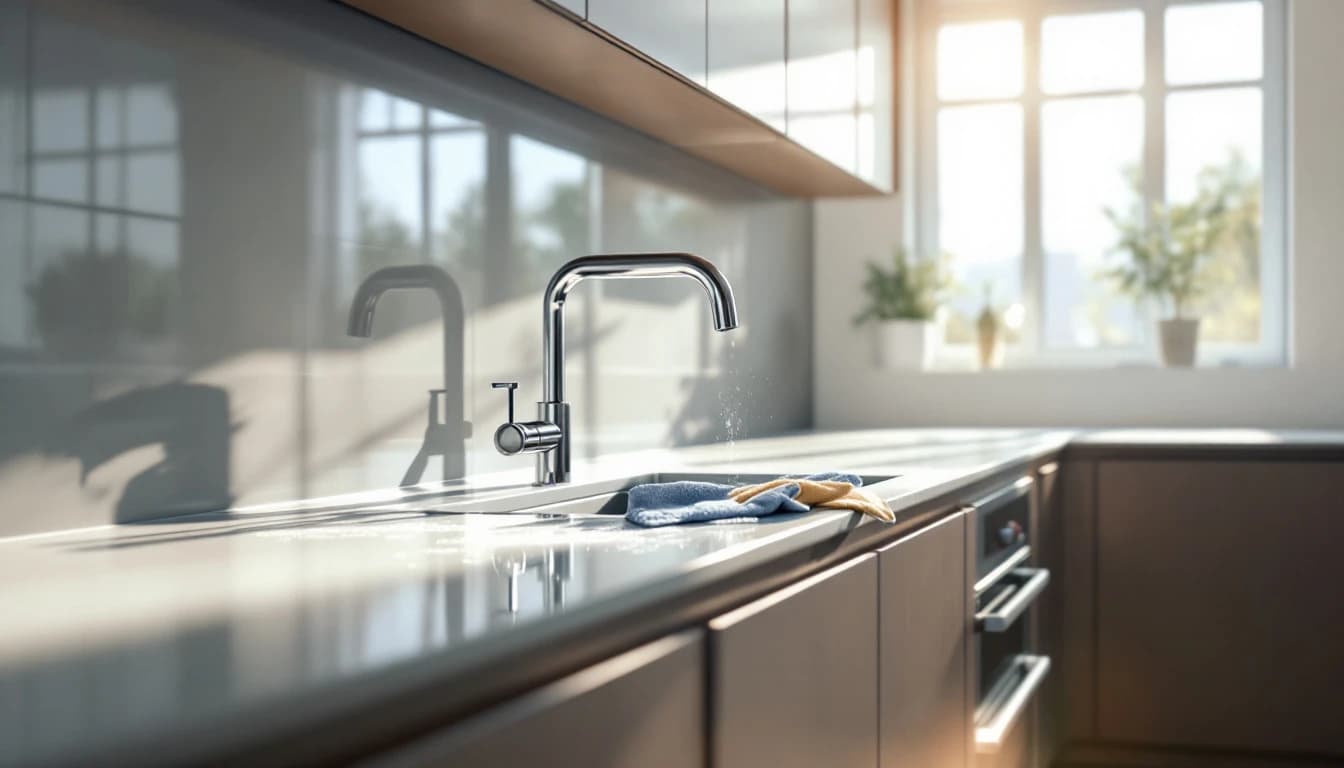
The kitchen sink is the fixture people forget. Everyone thinks about the shower and forgets that the kitchen faucet and sink have had water running over them several times a day for the entire tenancy. Stainless comes back beautifully — scale dissolves, spotting polishes out, and a bright sink is one of the first things anyone notices walking into an empty kitchen. Our kitchen deep cleaning guide goes further into the rest of that room.
For the broader hard-water picture across the western side of the metro, the Weatherford hard-water deep cleaning guide covers homes on similar water with the same mineral problem.
What to Do About It Before the Walkthrough
A short, practical sequence.
Do not attack it with abrasives. This is the most expensive mistake available. Scouring pads, abrasive powders, and razor blades on glass or on old porcelain convert a removable deposit into permanent scratching — and scratching genuinely is damage you caused, which changes who pays for it. If something is not coming off with proper descaling, the answer is that it is not a deposit, not that you need something harsher.
Get the descaling done as part of the move-out clean, on a vacant house. Scale work is time-consuming and it is far easier without a shower curtain, a full medicine cabinet, and a bath mat in the way. It is included in the flat rate, and it is one of the highest-value hours in the whole job because bathrooms are what inspectors check first.
Photograph the finished bathrooms specifically. Not just a wide shot of the room — close, well-lit shots of the shower glass, the tub surround, the fixtures, and the toilet. If there is etching or worn glaze, photograph that too, deliberately, so there is a record of what the surface looked like the day you left.
Separate the two categories in writing if you hand over a note. "Fixtures and glass descaled; lower door panel has pre-existing mineral etching that does not respond to cleaning" is a sentence that heads off an argument. Vagueness invites a deduction.
Check the move-in report. If you filled out a condition form when you moved in and noted the shower, that document does more work than anything else you can produce.
What the Flat Rate Covers
Move-in/move-out cleaning at $200 to $500 is a vacant whole-home clean measured against a walkthrough standard. Descaling of fixtures, glass, and porcelain is part of it, along with oven and refrigerator interiors, cabinet and drawer interiors, baseboards and door frames, window tracks and sills, blinds, light fixtures and ceiling fans, closet interiors, the laundry area, and floors corner to corner.
For comparison, a deep clean runs $200 to $450 and does comparable detail work in a home someone still lives in — that is the right service if you are staying and just want the bathrooms brought back. Move-out is its own category because vacancy is what makes the whole surface reachable and because the result gets inspected by someone with a financial interest in finding something.
Where a River Oaks home lands in the range comes down to bedroom and bathroom count, whether appliances stay, whether there is a garage, and condition. Most of the compact post-war homes here sit in the lower half. We quote one flat number before we start, never hourly, and never a "call for pricing" runaround — you should be able to budget a move without guessing.
To book, call (682) 201-2909 or email info@lauramaidservices.com with your move date, the bedroom and bathroom count, and whether the home will be empty. Mention the bathrooms specifically if you already know the scale is heavy, and we will plan the time for it. We have served River Oaks, Fort Worth, and the west side since 2003. You can also start from the River Oaks cleaning hub, the River Oaks move-in/out page, the move-in/move-out service page, or the White Settlement house cleaning page just north of the river.
Frequently Asked Questions
Can hard water stains be completely removed from a shower door?
The deposit can, entirely. Soap scum and mineral scale sitting on top of the glass dissolve with proper descaling and the glass comes back clear. What does not come off is etching, which is pitting in the glass itself from years of mineral contact - that is damage to the surface rather than a layer on it, and no cleaning product reaches it.
How do I tell if my shower glass is etched or just dirty?
Wet the glass and look at it while wet. Removable deposits largely vanish when the water fills the texture; etching stays visibly cloudy. A fingernail also catches on the edge of scale but slides smoothly across etched glass. Etching usually covers the lower third of a door evenly, while deposits follow the spray and drip pattern.
What does move-out cleaning cost in River Oaks, TX?
Move-in/move-out cleaning runs $200 to $500 as a flat rate quoted before work begins. Most of the compact post-war homes in River Oaks sit in the lower half of that range. Bedroom and bathroom count, whether appliances stay with the property, whether there is a garage, and the condition of the home are what move the number.
Can my landlord charge me for hard water stains I did not cause?
Texas state law allows deductions for damage and for cleaning beyond normal wear and tear, but not for ordinary wear itself. Mineral etching that built up across many years and likely multiple tenancies is difficult to attribute to a current tenant, which is exactly why documentation matters. Photograph the descaled bathrooms and any permanent etching before you hand over keys, and check your move-in condition report.
Will scrubbing the stains off myself before the inspection help?
Only with the right approach. Proper descaling helps; abrasive pads, scouring powders, and blades on glass or old porcelain turn a removable deposit into permanent scratching, and scratching is damage you caused. If something will not come off with normal descaling, that is the signal it is not a deposit - not the signal to use something harsher.
Is descaling included in the move-out clean or is it extra?
It is included. Hard-water descaling on fixtures, glass, and porcelain is a standard part of the move-in/move-out service within the $200 to $500 flat rate, not an add-on. If you already know the buildup is heavy, say so when you book so the time is planned for rather than discovered on the day.