2026 guide to disinfecting and sanitizing services in Fort Worth — cleaning vs sanitizing vs disinfecting, dwell time, high-touch points, and honest limits
Most people use "clean," "sanitize," and "disinfect" as if they mean the same thing. They do not, and the difference decides whether a visit actually reduces the germs on a surface or just moves them around. As of August 2026, a lot of cleaning companies still market "disinfecting" as a spray-and-wipe upgrade, which is close to the opposite of how disinfectants work. This guide explains what each term means, why cleaning has to come first, why contact time is the step almost everyone skips, which surfaces genuinely matter, when a Fort Worth household or office needs a disinfection-focused visit, and where the honest limits of a cleaning service sit. We have served Fort Worth and the surrounding communities since 2006, and we would rather explain this properly than sell a fog machine.
Cleaning, Sanitizing, and Disinfecting Are Three Different Things
These are three distinct processes with three different goals, and the U.S. Centers for Disease Control and Prevention draws the same distinction in its public guidance on household and facility cleaning.
Cleaning physically removes dirt, dust, grease, food residue, and — incidentally — a large share of the germs on a surface. It works by mechanical action and detergent: soap lifts soil, the cloth carries it away, water rinses it off. Cleaning does not kill anything; it relocates it. That sounds like a weakness, but removal is genuinely effective — a properly cleaned counter has dramatically fewer microorganisms on it than it did five minutes earlier, because they left with the cloth.
Sanitizing reduces germs on a surface to a level considered safe by public health standards. It is a reduction standard, not an elimination standard, and it is what applies to food-contact surfaces — a cutting board, a high chair tray, the counter where you prep dinner.
Disinfecting uses a chemical product to kill specific pathogens on a hard, non-porous surface. It is the strongest of the three and the narrowest: hard surfaces only, targeting the specific organisms named on the product's label, and only under the exact conditions the label describes.
The practical consequence is that these are not tiers of the same service where you pick how much you want. They are steps in a sequence, and skipping the first one breaks the third.
Why Cleaning Must Come First
This is the part that gets ignored most often, and it is the reason a lot of "disinfecting service" is theater.
Disinfectants are chemically fragile in the presence of soil. Organic material — grease, food residue, body oils, dust, dried spills — shields microorganisms from contact with the disinfectant and, with some chemistries, neutralizes the active ingredient outright. Spray a disinfectant onto a greasy counter and much of it is consumed reacting with the grease rather than the bacteria underneath.
That is why the U.S. Environmental Protection Agency, which registers and regulates disinfectant products sold in the United States, requires directions for use that specify surface preparation, and why essentially every registered disinfectant's label says to apply it to a pre-cleaned surface. The label is not a suggestion. Under federal pesticide law it is legally binding — and contradicting it is also the fastest way to get no benefit from the product.
So the real sequence for any surface you want disinfected is:
- Clean it with detergent and mechanical action to remove soil.
- Rinse or wipe so detergent residue does not interfere with the disinfectant.
- Apply the disinfectant according to its label.
- Leave it wet for the full contact time.
- Let it air dry or wipe only after the contact time has elapsed, per the label.
A crew that does not do step one is not disinfecting. A crew that does not do step four is definitely not disinfecting, which brings us to the single most-skipped step in the industry.
Dwell Time: The Step Nearly Everyone Skips
Every registered disinfectant carries a required contact time — also called dwell time or wet time. It is the number of minutes the surface must remain visibly wet with the product for the kill claim on the label to be valid. Depending on the product and the organism, that can range from well under a minute to ten minutes or more.
Here is what happens in the real world: someone sprays a counter, wipes it immediately, and considers it disinfected. The surface was wet for four seconds; the label may have required four minutes. The chemical never had time to work. The surface has been cleaned — which is not nothing — but it has not been disinfected.
Contact time is also why "one-step cleaner-disinfectants" require care. They are formulated to tolerate light soil, which is useful, but they still carry a contact time and still need a cleaning pass on a genuinely dirty surface.
For a crew, honoring dwell time changes the workflow. You cannot spray-and-wipe your way through a bathroom. You apply the product to all the relevant surfaces first, work on something else while the clock runs, and come back. It is slower, it looks less busy, and it is the difference between a disinfection service and a marketing claim. When you evaluate any company advertising disinfecting, ask what contact time they use and how they honor it. A company that has not thought about it will not have an answer.
The High-Touch Point Inventory
Disinfecting an entire home is neither necessary nor useful. Pathogens do not spread from the middle of your living room floor — they spread from surfaces many hands touch in sequence. A disinfection-focused visit should concentrate on a defined list of high-touch points, where the transmission risk actually lives.
In a home, the meaningful list is shorter than people expect:
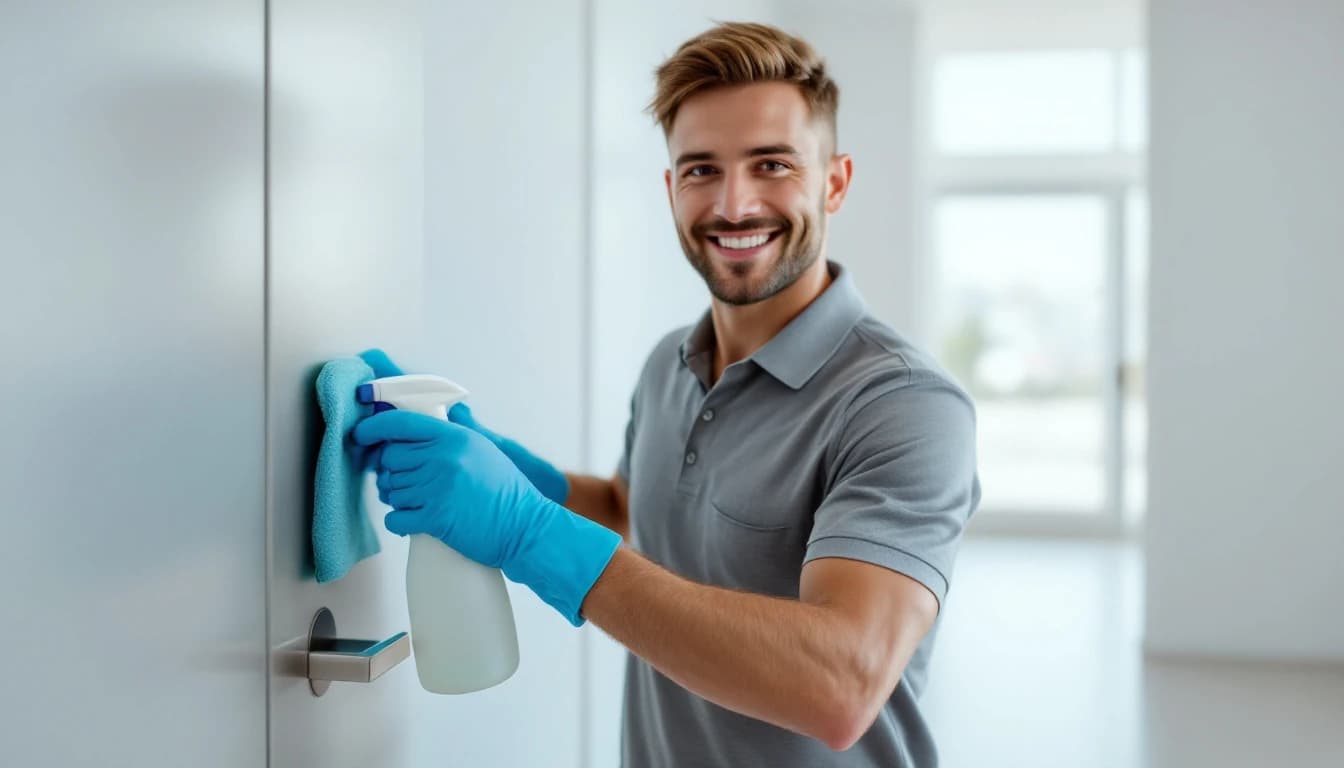
- Door handles and knobs, on both sides, including closet and cabinet pulls
- Light switch plates and dimmer panels
- Faucet handles and the toilet flush lever — the two most-touched, least-cleaned items in most houses
- Refrigerator, microwave, oven, and dishwasher handles
- Remote controls, game controllers, and tablet cases
- Stair railings and chair backs where people habitually grab
- Phone charging areas and the entry table where keys land
- Toilet seats, trash can lids, and pedals
In an office or shared workspace, add:
- Shared keyboards, mice, and desk phones
- Conference-room table edges, chair arms, and the remote or panel for the display
- Breakroom appliance handles, coffee machine buttons, and the water cooler tap
- Elevator buttons, stairwell rails, and reception counters
- Restroom door pulls — the surface every hand touches immediately after washing
- Shared printers and copier touchscreens
That inventory is a fraction of the total surface area in a building, and disinfecting it properly with correct contact time does more good than fogging every square foot. For the broader whole-home picture around this focused work, our house cleaning checklist for DFW homeowners covers routine scope and our deep cleaning service covers the intensive work.
When a Fort Worth Household Actually Needs a Disinfection Visit
Not every home needs this every visit. Routine cleaning does the majority of the germ-reduction work through removal alone, which is a large part of why the CDC's general household guidance treats regular cleaning as the baseline and disinfection as a targeted, situational addition. There are specific situations where a disinfection-focused visit is genuinely warranted:
Illness in the household. During and immediately after a stomach bug, flu, or any communicable illness moving through a family, high-touch disinfection meaningfully reduces the surfaces the next person picks it up from. This is the classic case.
Someone immunocompromised in the home. A resident on immunosuppressive therapy, undergoing cancer treatment, or living with a chronic condition that affects immune response changes the risk calculus. Here the standard is ongoing, not episodic.
A new baby. Newborn immune systems are still developing, and the surfaces adults touch and then hand a baby are the vector that matters.
After houseguests, contractors, or a large gathering. Any event bringing many hands through the house in a short window resets the surface picture — a common reason Fort Worth clients book a one-off before family arrives.
A shared office or a business with public foot traffic. Where the same surfaces are touched by dozens of unrelated people per day, high-touch disinfection is not situational — it is maintenance. Our office cleaning service builds it into a recurring schedule, and our Fort Worth office cleaning guide covers what that looks like locally.
A move-in. You have no idea what happened in that house before you got the keys, and it is the one moment when every surface is accessible.
| Situation | What is usually right | Frequency |
|---|---|---|
| Routine household, no illness | Standard cleaning, high-touch wipe-down | Every visit |
| Active illness in the home | Disinfection-focused visit, full high-touch list | During and just after |
| Immunocompromised resident | High-touch disinfection built into every visit | Ongoing |
| New baby in the home | Disinfection of nursery and shared high-touch points | Weekly to biweekly |
| After guests or a gathering | Targeted high-touch disinfection | One-time, as needed |
| Shared office or public traffic | High-touch disinfection on a schedule | Daily to weekly |
| Move-in to a new home | Deep clean plus full disinfection pass | Once, before move-in |
The Honest Limits of a Cleaning Service
This is the part most companies leave out, and leaving it out is how customers end up hiring the wrong trade for a serious problem.
A residential and commercial cleaning company — including ours — is not a remediation contractor and not a biohazard contractor. Those are separate, specialized, and in several cases separately regulated trades. Specifically:
- Mold beyond a small surface patch on a hard, non-porous surface is a remediation job. Visible mold on drywall, in HVAC systems, behind cabinets, or associated with a water intrusion needs an assessment and a remediation plan, not a cleaner with a spray bottle. Wiping visible mold without addressing the moisture source guarantees it comes back, and disturbing a colony can make the air quality worse.
- Sewage backups and flood water carry contamination that requires containment, specialized drying, and often the removal of porous materials. This is water-damage restoration work.
- Blood, bodily fluids beyond ordinary household cleanup, and crime or trauma scenes are biohazard remediation, with training and disposal requirements a cleaning company does not carry.
- Hoarding conditions, animal waste accumulation, and pest infestations each need their own specialist before cleaning is even possible.
- Sterilization — the complete elimination of all microbial life — is a clinical and industrial process. It does not happen in a house or an office, and any company claiming to sterilize a home is misusing the word.
A good cleaning company should tell you when a job is outside its lane and point you toward the right trade. Within our lane the work is straightforward and it matters: clean the surface, disinfect the ones that count, honor the contact time, and do it consistently. That covers the overwhelming majority of what a Fort Worth home or small office actually needs.
Booking a Disinfection-Focused Visit
Tell us the situation — illness in the house, an immunocompromised family member, a new baby, an office with public traffic — and we will scope the work around the surfaces that actually matter rather than selling a blanket upgrade. Standard house cleaning runs $120 to $250, deep cleaning $200 to $450, and office cleaning $150 to $400, all flat-rate based on the space rather than by the hour.
Call (682) 201-2909 or email info@lauramaidservices.com. You can also browse everything we offer locally from our Fort Worth cleaning services hub, set up recurring house cleaning in Fort Worth, or see the neighborhood-level detail for areas like TCU and the surrounding Fort Worth neighborhoods. If you are unsure whether you need a deep clean or a disinfection pass, our guide to what is included in a deep clean in Fort Worth draws the line clearly.
Frequently Asked Questions
What is the difference between cleaning, sanitizing, and disinfecting?
Cleaning physically removes dirt and a large share of germs using detergent and mechanical action — it does not kill anything, it carries it away. Sanitizing reduces germs to a level considered safe by public health standards and is the standard used for food-contact surfaces. Disinfecting uses a registered chemical product to kill specific pathogens on hard, non-porous surfaces. They are steps in a sequence rather than tiers of one service, and the CDC draws the same three-way distinction in its public cleaning guidance.
Why does a surface have to be cleaned before it is disinfected?
Because soil physically shields microorganisms from the disinfectant and, with some chemistries, neutralizes the active ingredient. Spraying a disinfectant onto a greasy counter means much of the product reacts with the grease rather than the bacteria beneath it. This is why registered disinfectants carry label directions specifying a pre-cleaned surface — and under federal pesticide law, which the EPA administers, those label directions are legally binding rather than advisory.
What is dwell time and why does it matter so much?
Dwell time, also called contact time, is the number of minutes a disinfectant must remain visibly wet on a surface for the kill claim on its label to be valid. It can range from under a minute to ten minutes or more depending on the product and the organism. Spraying and immediately wiping leaves the surface wet for a few seconds, which cleans it but does not disinfect it. Honoring dwell time changes the whole workflow — you apply to all surfaces first, wait, then return. Ask any company that advertises disinfecting what contact time they use; a company that has not considered it will not have an answer.
Which surfaces should a disinfecting service actually focus on?
The high-touch points, not the whole house. In a home that means door handles on both sides, light switch plates, faucet handles, the toilet flush lever and seat, appliance handles, remotes and controllers, stair railings, and entry surfaces. In an office add shared keyboards and mice, conference table edges, breakroom appliance and coffee machine buttons, elevator buttons, reception counters, and restroom door pulls. That list is a small fraction of total surface area and carries most of the transmission risk.
When does a Fort Worth home really need a disinfection-focused visit?
The clear cases are active illness moving through the household, an immunocompromised resident, a new baby, the period right after houseguests or a large gathering, a move-in to a home whose history you do not know, and any shared office or business with public foot traffic. For an ordinary healthy household, routine cleaning plus a high-touch wipe-down handles the majority of the germ reduction, because removal alone is genuinely effective.
Can a cleaning company handle mold, sewage, or biohazard cleanup?
No, and any company that says yes is worth a second look. Mold beyond a small patch on a hard surface is remediation work that requires addressing the moisture source; sewage backups and flood water are water-damage restoration; blood, bodily fluids beyond ordinary cleanup, and trauma scenes are biohazard remediation with training and disposal requirements a cleaning company does not carry. Sterilization — eliminating all microbial life — is a clinical process that does not happen in a house. We refer those jobs out rather than taking them.